
What Keeps It Going
Known water, repairable systems and replacement cost.
Owners know how their hulls behave. Local mechanics and fabricators still understand older equipment. Do-it-yourself labor changes the repair math. New packages make replacing the same basic function a five-figure decision.
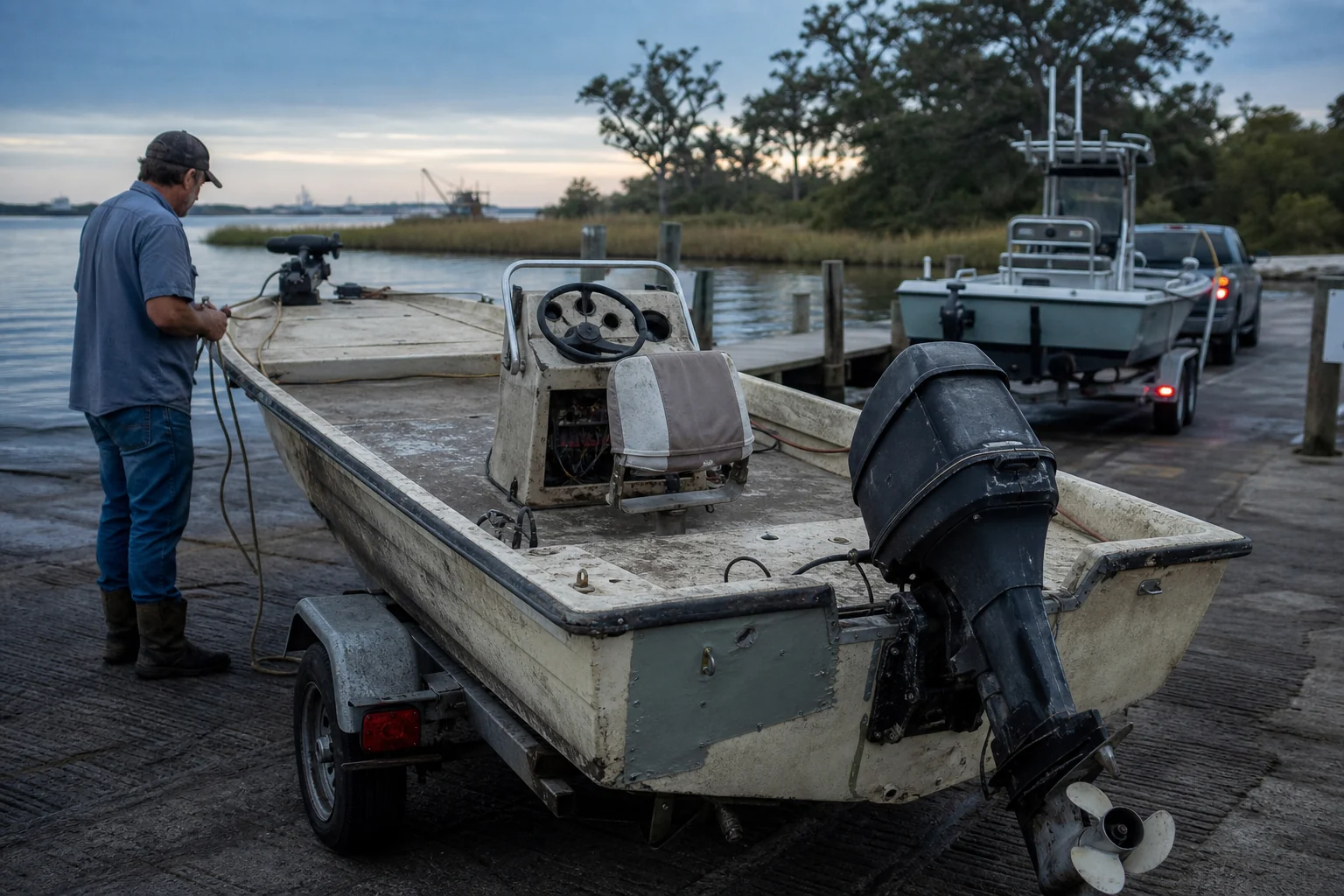
Along almost any Louisiana bayou, there is a boat that probably should have been retired years ago.
The gelcoat has faded. The carpet disappeared sometime during the Clinton administration. There are holes in the console where gauges used to live, a patch on the transom that does not quite match and enough old wiring under the dash to make tracing an electrical problem an archaeological project.
The motor may be just as old.
And Saturday morning, somebody is going to back the whole thing down a launch and go fishing.
There is a temptation to explain old boats with nostalgia. Sometimes that is part of it. But spend enough time around the people who actually keep them running and another explanation emerges.
For a lot of Louisiana fishermen, an old boat is not something they are preserving.
It is simply a boat that still works.
A different definition of old
Boats age differently from cars.
A 30-year-old automobile is unquestionably old. A 30-year-old fiberglass hull can be sitting beside a new boat at the launch, both headed toward the same marsh.
A fiberglass hull does not automatically become useless because another model year arrives. Floors can be replaced. Transoms can be rebuilt. Wiring can be stripped out and started over. Steering systems, pumps, gauges, controls and electronics can all be changed.
Even the engine can be replaced.
What remains is a boat its owner already knows.
He knows how shallow it will float. He knows what happens when a quartering sea catches it wrong. He knows where it sprays, where it pounds and how much throttle it wants crossing a particular stretch of rough water.
Those are not specifications printed in a brochure.
They are knowledge accumulated one trip at a time.
The people who keep them alive
Keeping an old boat running also requires something that has become less visible in a world increasingly built around replacement: people willing to repair things.
Louisiana still has them.
There are mechanics who can diagnose an outboard built before some of their customers were born. Fiberglass workers who can cut open a rotten deck and rebuild what is underneath. Welders who can put an aluminum hull back to work after years of hard use.
And then there are the owners themselves.
Boat ownership has always encouraged a certain amount of mechanical independence. When something breaks miles from the launch, waiting for roadside assistance is not an option.
Older boats take that a little further.
Fuel pumps get rebuilt. Carburetors get cleaned. Water pumps get changed in driveways. Trailer bearings get packed on Saturday night because somebody wants to fish Sunday morning.
A repair that would make little economic sense if every hour of labor were billed at a shop rate can make very different sense when the owner has tools, time and enough knowledge to do the work himself.
That changes the economics considerably.
The old two-stroke
Nowhere is that more obvious than on the transom.
Old Johnsons, Evinrudes, Mercurys and other conventional two-strokes remain familiar sights on Louisiana waterways even though the technology that dominates new-engine showrooms has changed dramatically.
The change was not simply fashion.
Federal emissions standards for new outboards began taking effect with the 1998 model year and phased in through 2006. EPA materials describing that phase-in identify four-stroke engines and direct-injected two-strokes as primary technologies manufacturers could use to meet the increasingly stringent standards.
Current EPA rules continue to regulate exhaust and evaporative emissions from new marine spark-ignition engines and vessels.
That history helps explain why the old carbureted two-stroke gradually disappeared from new-engine lineups.
It does not mean the engines already hanging on thousands of transoms suddenly stopped working.
For an owner, the attraction can be straightforward.
The mechanical systems on many older carbureted engines are familiar. A fuel or ignition problem can sometimes be diagnosed with ordinary tools and a service manual. Decades of widespread use also left behind used parts, donor motors and mechanics who learned these engines when they were new.
That does not make an old two-stroke cleaner or more efficient than modern technology.
It can make an engine someone already owns worth repairing.
Repair or replace?
The other side of that decision is sitting on dealership lots.
Modern boats are impressive.
Four-stroke outboards are quieter and cleaner than the conventional two-strokes many fishermen grew up with. Electronics can show structure and bottom detail at a level that would have seemed impossible a generation ago. Trolling motors can hold a boat on a spot using satellites.
None of that is imaginary progress.
Neither is the cost of replacing an entire fishing rig.
Current listings illustrate the point without looking at high-end offshore or bay boats. A new 2026 Tracker Super Guide V-16 SC package in Monroe, equipped with a 50-horsepower outboard, was listed at $20,690. A new 2026 Avid 16 Commander in Slidell, equipped with a 60-horsepower outboard, was listed at $24,495. Listings can change or be withdrawn.
Move into larger inshore packages and the price climbs quickly from there.
That changes the question surrounding an older boat.
It is no longer simply:
Is this boat worth fixing?
The better question may be:
What would it cost to replace what this boat allows me to do?
A fisherman with an old hull, a serviceable trailer and an outboard he understands may look at a soft floor or tired engine differently when the alternative is a five-figure replacement.
Repairs that appear excessive compared with the resale value of an old boat can make more sense when compared with the cost of replacing its function.
A $3,000 repair on a boat worth $4,000 may look foolish on paper.
It can look different if the alternative is spending $20,000 or more to get back on the water.
There is a limit
None of this means every old boat deserves another rebuild.
Rotten structural components matter. Transoms fail. Aluminum corrodes. Wiring can become dangerous. Fuel systems deteriorate. Old trailers can turn a fishing trip into a roadside problem before the boat ever reaches the water.
There is a point where sentiment becomes bad arithmetic.
There is also a point where unsafe equipment is simply unsafe.
Keeping something alive does not mean pretending it cannot die.
Sometimes the correct diagnosis really is that the boat has made its last trip.
But sometimes it is not.
More than vintage
The interesting boats are not necessarily restored classics.
Some are.
Others are ugly.
They have been modified repeatedly by people solving whatever problem existed at the time. A switch panel came from somewhere else. The seat does not match. Somebody added an aluminum plate where the fiberglass started getting questionable. The original motor is long gone.
There may be no collector waiting to buy them.
They have value because they remain useful.
And that may explain why old boats remain such a familiar part of Louisiana fishing.
The equipment has changed considerably over the generations. The basic job has not.
A boat still has to leave the launch, cross the water, reach wherever its owner is trying to go and get everybody home again.
There are boats throughout Louisiana that have been doing exactly that for 20, 30, 40 years or longer.
Eventually every one of them will make a final trip.
Just maybe not this weekend.
There might be another run left in it.
Source File
Sources and additional reading
- U.S. EPA: Regulations for emissions from marine spark-ignition engines
- U.S. EPA: Overview of marine-engine emission standards and the 1998–2006 outboard phase-in
- U.S. EPA: Marine gasoline engine and boat testing
- 2026 Tracker Super Guide V-16 SC listing, Monroe, Louisiana
- 2026 Avid 16 Commander listing, Slidell, Louisiana
Reader Response
What old rig are you still keeping alive?
Send LAInshore.com a photograph and the plain version of the story: what it is, what has been replaced, who keeps it running and why it still earns a place at the launch. Do not include registration numbers, addresses or other private information in the photograph.
Send a response