
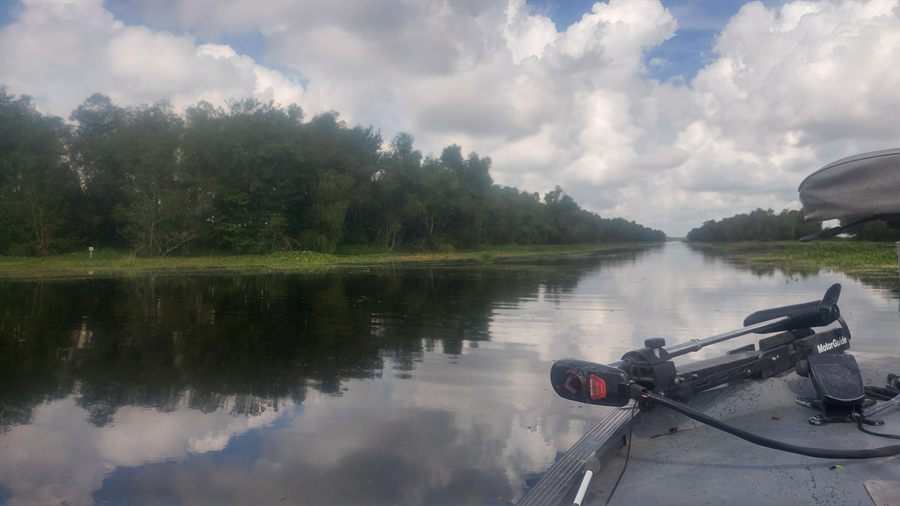
Carbon capture is usually discussed as an energy issue. In Louisiana, it quickly turns into a water and land issue.
These projects can involve more than equipment inside a plant fence. Depending on the proposal, they can mean pipelines, compressor stations, injection wells, monitoring wells, private property, public water bottoms, lakes, marshes, old oilfield areas, and emergency plans for nearby communities.
For anyone who fishes, crabs, works, owns land, or lives around Louisiana water, the subject is worth understanding before it becomes another permit map.
Carbon capture is usually described as CCS or CCUS. CCS stands for carbon capture and storage. CCUS stands for carbon capture, utilization, and storage. The basic idea is to capture carbon dioxide from an industrial source, compress it, move it by pipeline, and either use it in another process or inject it deep underground for long-term storage.
Supporters say the technology can help Louisiana keep major industrial jobs while reducing emissions from facilities that are difficult to clean up through other methods. Critics question whether the benefits justify the cost, the infrastructure, the public subsidies, and the long-term responsibility placed near communities, waterways, and private property.
The details matter: where a project is, what it crosses, who regulates it, what is stored, how it is monitored, and who remains responsible over time.
Why Louisiana Is a Target for Carbon Capture
Louisiana already has the plants, pipelines, ports, and wells that make carbon capture attractive.
Refineries, chemical plants, ammonia facilities, LNG projects, ports, pipelines, and oil-and-gas infrastructure are part of the state’s economy. Louisiana also has large industrial emission sources, existing pipeline corridors, experience with drilling, and underground geologic formations that companies and regulators consider suitable for carbon storage.
In January 2026, ExxonMobil said its first commercial carbon capture and storage operation with CF Industries in Louisiana had started in 2025. The project is tied to CF’s Donaldsonville ammonia complex and is designed to transport and store up to 2 million metric tons of CO₂ per year. ExxonMobil also said it had other CCS projects expected to come online in 2026. (ExxonMobil)
For supporters, projects like that show how Louisiana can use its industrial base while reducing carbon emissions from large facilities.
For opponents and concerned residents, the same project category raises questions about pipeline routes, underground storage, public money, emergency planning, and whether nearby communities get enough information before decisions move forward.
Why Supporters Say Louisiana Needs It
Supporters of carbon capture usually make three main arguments.
The first is economic. Louisiana’s industrial base supports jobs, contractors, ports, tax revenue, and local businesses. If future markets, lenders, or regulations favor lower-carbon products, supporters argue that Louisiana needs a way to keep existing industries competitive.
The second is practical. Some industries are difficult to decarbonize. Ammonia, cement, steel, refining, and chemical production do not all have simple replacements. Carbon capture is often presented as one available tool for reducing emissions from those sectors.
The third is transitional. Supporters see CCS as a bridge technology that could lower emissions while the economy still depends on fuels, chemicals, fertilizer, plastics, and other products made by heavy industry.
That is the strongest version of the pro-CCS argument: Louisiana already has the plants, the jobs, the infrastructure, and the emissions. If carbon capture can reduce part of that footprint while keeping the economic base intact, supporters say it deserves serious consideration.
Why Critics and Residents Are Concerned
Critics do not all come at this from the same place.
Some oppose carbon capture because they believe it extends fossil-fuel infrastructure and delays larger changes in energy and industry. Others are less focused on national climate policy and more concerned about local impacts.
In Louisiana, those local questions can be direct.
Where will the pipelines run?
Will they cross private land, marsh, wetlands, bayous, lakes, or public water bottoms?
How close will they be to homes, camps, boat launches, roads, schools, or commercial fishing areas?
What old wells are near the injection zone?
What happens if CO₂ moves in a way engineers did not expect?
Who responds if there is a leak?
Who pays for monitoring after the company that built the project is gone?
Those are the questions communities tend to ask when a new industrial project has long-term land, water, and safety implications.
Lake Maurepas Became the Example
Lake Maurepas became one of Louisiana’s most visible carbon capture disputes.
Air Products had proposed a large Louisiana Clean Energy Complex that would produce low-carbon hydrogen, with captured carbon dioxide planned for storage beneath Lake Maurepas. The proposal drew opposition from some lake residents, fishermen, local officials, and preservation groups concerned about drilling, seismic work, pipelines, injection wells, old wells, and effects on the lake.
In July 2024, The Guardian reported on local opposition to the proposed storage beneath Lake Maurepas, including concerns about abandoned wells and Louisiana’s industrial history. (The Guardian)
On June 30, 2026, Air Products announced that it would not proceed with its Louisiana Clean Energy Complex because expected financial returns did not meet the company’s criteria. The company said the project exit and other portfolio actions would result in pre-tax charges not expected to exceed $2.9 billion. (Air Products filing with the SEC)
That does not settle the broader carbon capture debate in Louisiana. It does show why the details matter early. A project can involve large investment, major public interest, strong local opposition, complicated permitting, and then still change direction for financial reasons.
CO₂ Pipeline Safety Questions
Carbon dioxide is not flammable like natural gas, but it can still be dangerous in high concentrations.
CO₂ can displace oxygen. It can collect in low areas. If released suddenly, it can create an emergency that is different from a natural gas leak or chemical spill.
The incident most often raised in CO₂ pipeline discussions happened near Satartia, Mississippi, in February 2020. According to the federal investigation, local authorities evacuated about 200 people and 45 people sought medical attention after a CO₂ pipeline ruptured. (PHMSA failure investigation report)
That incident does not prove every CO₂ pipeline is unsafe. It does show why emergency planning matters.
For Louisiana communities, especially rural areas with two-lane roads, scattered homes, camps, low ground, and limited emergency resources, the practical questions are important:
Do local responders know the route and contents of the pipeline?
Are they trained for a CO₂ release?
Are residents told what to do in an emergency?
Can vehicles safely enter or leave the area?
Who monitors the line?
How quickly is the public notified?
Those questions should be answered plainly before a project is approved, not treated as technical details for later.
Underground Storage and Old Wells
Carbon storage depends on geology. The CO₂ must be injected into a suitable underground formation and kept there over time.
Supporters say Class VI injection wells are specifically designed and regulated for geologic carbon storage. They also argue that Louisiana’s oil-and-gas experience gives the state technical knowledge that can help manage these projects.
Critics and some residents point to the same history and reach a different concern. Louisiana has many old wells, legacy oilfield areas, and industrial sites. If carbon dioxide is stored underground, the public needs confidence that old wells, poor records, or unexpected pathways will not create problems for groundwater or surface areas.
That does not mean every storage site is unsuitable. It means site selection, well reviews, monitoring, and long-term liability are central to the public-interest question.
Who Watches These Projects?
Carbon storage wells are regulated through the underground injection control system. Class VI wells are the category used for geologic carbon storage.
States can seek authority, known as primacy, to run their own Class VI permitting programs if they meet federal requirements. The EPA granted Louisiana Class VI primacy in December 2023. Class VI wells in Louisiana are now regulated through the Underground Injection Control program within the Department of Conservation and Energy’s Office of Permitting and Compliance. (Louisiana Class VI program)
Supporters of state primacy say it can allow faster permitting and put decisions closer to local geology and state expertise. Critics worry that faster permitting could reduce public confidence if staffing, enforcement, transparency, or public access to information are not strong enough.
Industry wants a clear and timely permitting path.
Residents want confidence that permits are reviewed carefully, monitoring is real, violations are enforced, and project information is easy to access.
Both sides have a real point. A slow process with no clear standards can discourage investment. A fast process with weak public trust can create lasting conflict.
Property Rights and Pipeline Routes
Carbon capture can also become a property-rights issue.
Pipelines require routes. Routes may cross farms, timberland, marsh, camps, rural neighborhoods, or private family property. Some landowners may support a project. Others may not want a CO₂ pipeline across their land, regardless of the climate or industrial argument behind it.
That issue has already become a major fight in other states. In 2025, South Dakota enacted a law prohibiting eminent domain for pipelines whose primary purpose is transporting carbon oxide, showing that carbon capture can raise property-rights concerns even in states with strong energy and agricultural interests. (South Dakota Session Law, Chapter 190)
Louisiana has its own history with pipelines, servitudes, land access, coastal impacts, and private property disputes. Any carbon capture buildout that requires new pipeline routes will likely face similar questions here.
The Climate Debate
Carbon capture is promoted as a climate tool because it can reduce the amount of CO₂ released from certain industrial sources.
The main argument for it is that some emissions are difficult to eliminate quickly, and storing carbon underground may be better than releasing it into the atmosphere.
The main argument against it is that CCS can become expensive, subsidy-dependent, and used to extend fossil-fuel infrastructure while leaving other environmental and community concerns unresolved.
A carbon capture project may reduce carbon emissions from a specific facility. That does not automatically answer every question about cost, local pollution, pipeline risk, groundwater protection, long-term monitoring, or whether the public is receiving enough benefit for the public support involved.
It also does not mean the technology should be dismissed in every case. Louisiana’s industrial economy is real, and the state will face pressure to reduce emissions while keeping jobs and investment.
The question is whether each project can prove its value, safety, transparency, and accountability on the ground.
What Anglers, Crabbers, and Landowners Should Look For
For anglers, crabbers, shrimpers, marina owners, camp owners, and waterfront residents, the most important part of the carbon capture debate may not be the national climate argument.
It may be the project map.
Before any project moves forward, the public should be able to understand:
- Where pipelines will run.
- Where injection wells will be located.
- What waterways, lakes, marshes, wetlands, or public water bottoms may be involved.
- What old wells are near the storage area.
- How groundwater will be protected.
- How long monitoring will continue.
- Who will pay for long-term monitoring.
- What emergency plans exist for nearby communities.
- What information will be public.
- Who remains responsible if ownership changes.
Those are not anti-industry questions. They are basic questions for any project that touches land, water, public safety, and long-term responsibility.
Bottom Line
Carbon capture is likely to remain part of Louisiana’s industrial and environmental discussion.
Supporters see it as a way to protect jobs, attract investment, and reduce emissions from facilities that are difficult to replace. Critics see unresolved questions about cost, public subsidies, pipeline safety, underground storage, property rights, and long-term responsibility.
For Louisiana water users, the issue is not simple.
A project can promise emissions reductions and still deserve hard questions about land, water, safety, and oversight. A community can support jobs and industry while still asking for clear maps, public information, emergency planning, and accountability.
When carbon capture projects involve pipelines, injection wells, lakes, marshes, public water bottoms, private property, or communities built around working water, they are no longer just energy projects.
They are Louisiana water issues too.
Sources & Further Reading
- Louisiana Department of Conservation and Energy: Class VI Carbon Sequestration Program
- Louisiana Class VI permits and applications
- U.S. EPA: Class VI wells and drinking-water protections
- PHMSA: Satartia pipeline failure investigation
- ExxonMobil: CF Industries CCS operation
- Air Products: Louisiana Clean Energy Complex decision
- Air Products: Louisiana Clean Energy Complex project overview
- The Guardian: Lake Maurepas opposition and community concerns
- South Dakota Session Law, Chapter 190
Reader Response
Have a local correction, firsthand detail, or respectful response?
Send it to LAInshore.com. Include the article title, what you saw or know, and any source, photo, document, or public record that helps verify it. Useful reader responses may inform corrections, updates, or follow-up reporting.
Send a response