
Editor’s Note
Industry responses will follow.
LAInshore.com contacted several major fishing-equipment manufacturers and industry representatives for comment on affordability, pricing and the divide between premium products and ordinary anglers. Their responses will be covered in a separate follow-up article.
The annual ICAST trade show is where the fishing industry shows the world what comes next.
New rods are lighter. Reels are smoother. Electronics see farther and produce clearer images. Trolling motors hold boats in place, communicate with chartplotters and steer themselves. Modern anglers have access to capabilities that would have seemed impossible a generation ago.
But ICAST 2026 also highlighted a growing divide within recreational fishing.
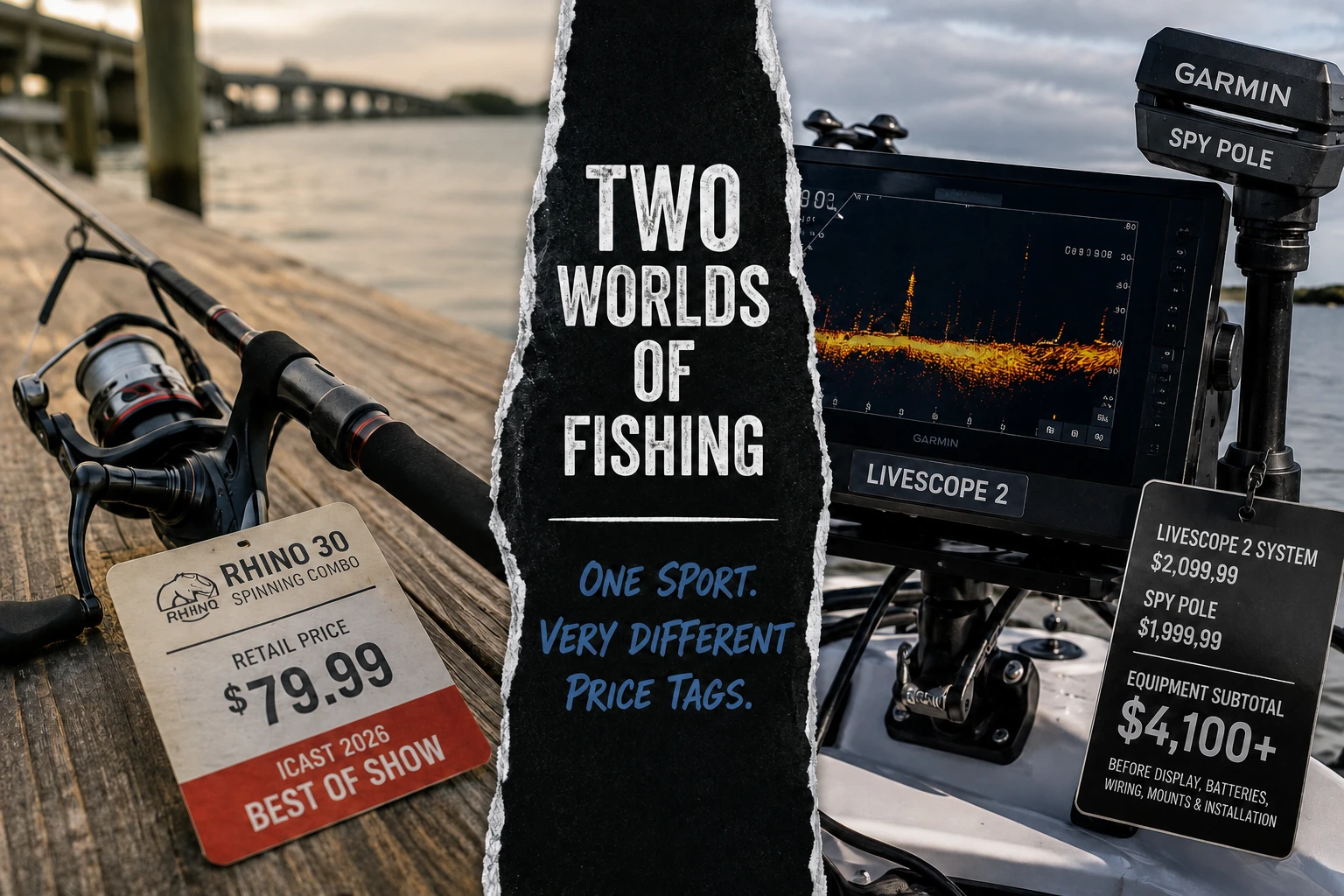
On one side was the Rhino 30 spinning combo, an affordable rod-and-reel package priced at roughly $70 to $90. It won ICAST Best of Show.
On the other were electronics and accessories priced in the thousands, including Garmin’s new LiveScope 2 systems and motorized sonar equipment.
The contrast was difficult to miss.
The industry still understands that affordable fishing equipment matters. At the same time, much of its most heavily promoted innovation now exists in a price range many working anglers cannot comfortably reach.
That raises a question worth asking in Louisiana, where fishing has traditionally belonged as much to mechanics, plant workers, truck drivers, welders and construction hands as it has to tournament professionals:
Is the fishing industry’s center of gravity moving away from the working anglers who have long formed much of its customer base?
One show, two fishing economies
ICAST is not a consumer boat show. It is the sportfishing industry’s largest trade gathering, where manufacturers introduce new products and retailers, buyers and media select the New Product Showcase winners.
The Rhino 30 combo’s selection as Best of Show was significant. Rather than honoring the most expensive or technically complicated product in the building, voters selected a relatively accessible rod-and-reel package designed around durability and practical use.
That result suggests affordability still carries considerable value inside the industry.
But many of the show’s headline products told a different story.
Garmin introduced its LiveScope 2 series with suggested retail prices ranging from $1,999.99 to $2,199.99. The company says the new generation offers greater resolution, increased range, improved target separation and a simplified installation that eliminates the separate black box required by earlier systems.
Those are meaningful improvements, not merely cosmetic changes.
The sonar still requires a compatible Garmin multifunction display.
Garmin’s motorized Spy Pole mount starts at $1,999.99. Pairing a roughly $2,100 LiveScope 2 system with the $1,999 Spy Pole brings the equipment subtotal to about $4,100 before adding a compatible display, batteries, wiring, mounting hardware or installation.
None of that necessarily means the products are overpriced for what they contain. Advanced sonar requires research, engineering, specialized components, software development and continued support.
It does mean that one modern electronics upgrade can cost more than some Louisiana anglers paid for their entire used boat.
What those prices mean in Louisiana
Sticker prices look different when measured against household income.
Louisiana’s median household income was $60,756 in 2020–2024 estimates stated in 2024 dollars, according to the U.S. Census Bureau. The state’s per-capita income was $35,038, and 18.7 percent of Louisiana residents lived below the poverty line.
A $4,100 sonar-and-mount subtotal equals approximately 6.7 percent of Louisiana’s median annual household income.
That comparison uses gross household income, not what remains after taxes, housing, insurance, groceries, utilities, transportation and other family expenses.
For workers in common blue-collar occupations, the distance can feel even greater.
The Bureau of Labor Statistics reports median annual pay of $46,050 for construction laborers and helpers, $48,620 for general maintenance and repair workers and $57,440 for heavy and tractor-trailer truck drivers.
For a maintenance worker earning the national median for that occupation, a $4,100 equipment purchase represents more than 8 percent of annual gross pay.
That does not make the product illegitimate. It shows why working anglers may experience modern fishing innovation differently from the professionals, influencers and sponsored anglers commonly used to promote it.
The average angler is not spending like a professional
Nearly 40 million Americans age 16 and older went fishing in 2022, according to the U.S. Fish and Wildlife Service. Together, they spent approximately $99.4 billion, or an average of about $2,490 per angler for the year.
That amount includes more than rods and reels. It covers equipment, trips, transportation, licenses and other fishing-related expenses.
A roughly $4,100 sonar-and-pole purchase therefore costs about 165 percent of what the average angler spent on all fishing-related activity during the year measured by the federal survey.
The comparison is imperfect because annual spending varies widely between anglers, but it illustrates how one premium upgrade can exceed an average participant’s total fishing expenditures for an entire year.
Meanwhile, participation remains broad.
The Recreational Boating and Fishing Foundation reported that a record 57.7 million Americans age six and older fished during 2023. Participation, however, does not necessarily mean frequent participation.
One-third of anglers went fishing only one to three times, and nearly seven in ten went less than once per month.
That presents a challenge for the industry.
Fishing needs occasional anglers, young families and newcomers. They buy licenses, support local tackle shops, contribute through excise taxes and help build the political base needed to protect fisheries and public access.
But a person who fishes five or six times a year is unlikely to justify thousands of dollars in electronics, batteries and integrated boat systems.
The industry is attracting more participants while much of its most visible equipment is being developed for its most committed—and often most financially capable—customers.
Boats show the divide even more clearly
Rod and reel prices have not all moved in the same direction.
Some established midpriced reels have remained relatively stable in nominal dollars. Affordable combos remain widely available. A person can still walk into a store, buy a functional setup and catch redfish or speckled trout without spending a week’s pay.
Boats are another matter.
The federal Producer Price Index for wood and metal outboard motorboats reached 184.260 in June 2026, using June 2011 as a baseline of 100. The comparable index for fiberglass and plastic outboard boats reached 187.631.
That indicates manufacturer-level prices in those categories increased approximately 84 to 88 percent over 15 years.
The index is not a retail showroom price, and it includes boats beyond the Louisiana recreational market. It nevertheless confirms what anglers have seen firsthand: outboard-powered boats have become substantially more expensive to manufacture and purchase.
Many new bay boats now carry prices comparable to new pickup trucks, while fully equipped premium rigs can reach six figures.
Long financing terms make the monthly payment appear manageable, but they do not make the boat inexpensive. They spread the cost over more years, potentially keeping an angler in debt through multiple engines, electronics generations and major repair cycles.
Rising prices have more than one cause
It would be easy to blame the entire affordability gap on manufacturers chasing larger profits. The evidence is more complicated.
Boat and tackle companies have faced higher costs for aluminum, resins, electronics, labor, freight and imported components. Tariffs and supply disruptions also affect what manufacturers pay before a finished product reaches a store.
Private-industry compensation costs increased 3.4 percent during the year ending in March 2026, according to the Bureau of Labor Statistics. After adjusting for inflation, compensation increased only 0.1 percent.
Workers gained very little real purchasing power even as the dollar cost of many goods continued rising.
Manufacturers are paying more for many of the things required to build products. Workers are being paid somewhat more in dollars but are not necessarily becoming substantially better able to afford them.
The other force is premiumization.
Fishing companies know there is a segment of the market willing to pay for greater range, better displays, quieter motors, integrated controls and measurable performance advantages. As long as those customers continue buying, companies have a strong reason to keep developing increasingly capable systems.
Tournament fishing and social media intensify that pressure.
Anglers repeatedly see boats equipped with multiple large screens, live sonar, 360-degree imaging, shallow-water anchors, lithium battery banks and advanced trolling motors. Equipment that was once exceptional begins to look standard.
It may not be necessary to catch fish, but it can begin to feel necessary to be taken seriously.
Better equipment provides real value
The affordability argument should not ignore what anglers receive in return.
Modern trolling motors can keep a boat positioned in wind and current more effectively than older equipment. Better batteries reduce weight and provide longer run times. Improved sonar can reveal structure, bait and fish that traditional equipment may miss. Modern reels often provide better sealing, drag systems and corrosion resistance.
For charter captains and serious tournament anglers, these products may be business investments rather than recreational luxuries. Reliability, efficiency and the ability to locate fish quickly can directly affect income.
Technology also tends to move downward.
Features introduced on premium equipment frequently reach midpriced products in later generations. Yesterday’s flagship chartplotter becomes tomorrow’s affordable used unit. Anglers who do not need the newest system can benefit from the technology race without paying its opening price.
The Rhino combo’s Best of Show victory also matters. It demonstrates that the industry has not completely lost sight of durability, simplicity and attainable pricing.
Fishing is still accessible—but its image is changing
A person does not need live sonar to catch a redfish.
He does not need three screens, a lithium battery bank or a trolling motor connected to a wireless network. Louisiana fish are still caught every day from jon boats, aluminum skiffs, kayaks, roadside banks and aging center consoles held together by maintenance, ingenuity and stubbornness.
Fishing has not become a pastime only for the wealthy.
But the version of fishing most heavily promoted by manufacturers, tournament coverage and online personalities increasingly centers on equipment many ordinary anglers cannot afford.
That distinction matters.
When newcomers believe they need thousands of dollars in gear before they are properly equipped, the industry creates a barrier that may exist more in perception than reality—but can still keep people off the water.
When experienced working anglers feel that every product cycle pushes them another step behind, they may stop upgrading, buy used equipment or leave certain parts of the market altogether.
The industry needs its premium customers. Innovation is expensive, and serious anglers will always pay for useful advantages.
It also needs the mechanic fishing after work, the father putting together his child’s first rod, the plant worker keeping a 20-year-old boat alive and the retiree who cannot replace everything when prices jump.
Those anglers are not the bottom end of the fishing market. They are its foundation.
ICAST 2026 placed both versions of the industry under one roof: a sub-$100 combo won the biggest award in the building, while some of its most discussed technology cost several thousand dollars before a boat ever left the trailer.
The affordable path still exists.
The question is whether the industry will continue treating it as a central part of fishing—or merely the first rung on an increasingly expensive ladder.
Source File
Sources and data
- ICAST 2026 Best of Show: Rhino 30 spinning combo
- Garmin LiveScope 2 product details and pricing
- U.S. Census Bureau QuickFacts: Louisiana
- BLS: Construction laborers and helpers
- BLS: General maintenance and repair workers
- BLS: Heavy and tractor-trailer truck drivers
- U.S. Fish and Wildlife Service: 2022 National Survey
- Recreational Boating and Fishing Foundation: 2024 Special Report on Fishing
- Federal Reserve Economic Data: June 2026 boat Producer Price Indexes
- BLS Employment Cost Index, March 2026
Reader Response
What does affordability look like from your side of the counter?
Anglers, tackle shops, manufacturers, installers and marine businesses can send corrections, firsthand pricing context or a respectful response. Include the article title and any source, document or public information that helps verify the point.
Send a response