
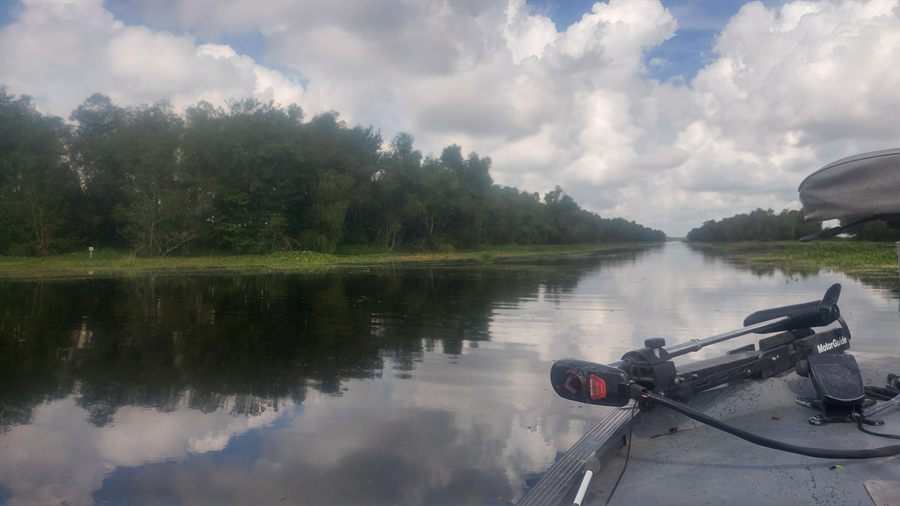
The Louisiana Department of Wildlife and Fisheries says it released 5,500 striped bass into the Pearl River as part of an effort to restore a native fish species.
The June 15 announcement is not the kind of item that will get the same attention as a redfish rule change, trout limit, shrimp-season notice, or menhaden fight.
But it still belongs on the Louisiana inshore radar.
The Pearl River system sits on the edge of several fishing worlds at once: freshwater, brackish water, Northshore fishing, Lake Pontchartrain influence, Mississippi border water, public access, and long-running habitat questions. A striped bass restoration effort there is not a direct redfish-and-trout story, but it is a public-fisheries story.
And public fisheries are part of what LAInshore.com is here to follow.
What LDWF did
LDWF posted on June 15, 2026, that it released 5,500 striped bass into the Pearl River to help restore a native fish species.
The agency has also been running the Striped Bass Collaborative Anglers Project, or SBCAP, to better understand striped bass in the Lake Pontchartrain and Pearl River basins.
That project area includes Louisiana waters east of the Mississippi River, including Lakes Maurepas, Pontchartrain and Borgne, the rivers draining into those lakes, and the entire Pearl River system.
This is not a random stocking effort dropped into an unrelated water body.
LDWF describes the Pearl River and Lake Pontchartrain basins as the western edge of the historical range of the Gulf Strain striped bass population. The agency has been working with the U.S. Fish and Wildlife Service on a cooperative effort to restore a historical Gulf Strain striped bass population within those basins.
Why striped bass matter here
Striped bass are not usually the first fish most Southeast Louisiana inshore anglers talk about.
Speckled trout, redfish, flounder, bass, sac-a-lait, catfish, shrimp, crabs and oysters usually dominate the conversation depending on where the angler lives and fishes.
But striped bass have a real place in the Pearl River and Lake Pontchartrain discussion.
LDWF's striped bass project is focused on understanding genetics, movement, habitat use, and stocking potential. The agency is trying to determine whether fish caught in the study area are Gulf Strain, Atlantic Strain, natural, stocked, or some combination.
That matters because restoration is not only about putting fish into water.
It is about whether the right fish can survive, move, grow, reproduce, and use the available habitat.
LDWF has said larger Gulf Strain striped bass need access to cooler water during summer, with temperatures under 75 degrees considered important. In South Louisiana, finding that kind of summer refuge can be difficult. That is one reason the agency is tracking fish movement with acoustic telemetry and asking anglers to help collect samples.
In plain language: stocking fish is only one part of the work. LDWF is also trying to learn whether the system can support them and where the limiting factors are.
What this could mean for anglers
For anglers, the most realistic takeaway is not "go catch striped bass tomorrow."
A 5,500-fish release is a restoration step, not a guarantee of a new fishery.
Some stocked fish may survive. Some may not. Growth, movement, water temperature, forage, habitat, harvest, predation, genetics, and future stockings will all matter.
If the effort succeeds over time, anglers in the Pearl River and Lake Pontchartrain region could eventually have more opportunity to encounter striped bass as part of the larger public fishery.
But that is a long-game outcome.
The useful near-term role for anglers may be helping LDWF gather information.
LDWF has asked anglers who catch striped bass in the project area to support its sampling work through fin clips or carcass collection. Those samples can help biologists determine age and genetic origin.
That kind of citizen data can matter because striped bass are not as commonly encountered as more familiar Louisiana species. Every reliable sample can help fill in the picture.
What it does not mean
This release does not mean the Pearl River suddenly has a major striped bass fishery.
It does not mean regulations changed.
It does not mean anglers should move fish themselves.
It does not mean anyone should stock fish without approval. Louisiana regulations state that no fish from outside the state may be liberated in Louisiana without written permission from the LDWF secretary.
It also does not mean striped bass will replace existing fisheries or become the next dominant target.
This is a restoration and research story.
The right way to read it is as one piece of a longer LDWF effort around Gulf Strain striped bass in the Pearl River and Lake Pontchartrain basins.
Why this fits LAInshore.com
LAInshore.com will always pay close attention to the saltwater and brackish issues that directly affect redfish, trout, flounder, bait supply, boat launches, public water, commercial fishing, and coastal habitat.
But the edge waters matter too.
The Pearl River system, Lake Pontchartrain, Lake Borgne, rivers draining into the lake system, and the Northshore all sit inside the larger Louisiana fishing conversation. Freshwater and inshore issues overlap more than clean categories suggest.
A stocking project like this raises questions worth following:
Will future stockings continue?
Where did the fish come from?
How will LDWF measure success?
What survival rate does the agency expect?
What do angler samples show about genetics and age?
Where do tagged fish move during summer?
What habitat limits striped bass recovery?
Could the effort create a meaningful public fishery over time?
Those are not hype questions.
They are follow-up questions.
What anglers should do
If you fish the Pearl River system, Lake Pontchartrain, Lake Maurepas, Lake Borgne, or connected rivers east of the Mississippi River, be aware that LDWF is looking for striped bass information.
If you catch a striped bass, check LDWF's Striped Bass Collaborative Anglers Project page for current sample instructions. LDWF has asked for either fin clips or cleaned carcass samples, depending on whether the fish is released or harvested.
Anglers should also pay attention to identification. Striped bass, hybrid striped bass, white bass, and yellow bass can be confused by people who do not catch them often. LDWF's project page includes identification materials for that reason.
Most importantly, do not turn one stocking notice into a rumor.
This is not a promise of immediate action at the boat ramp.
It is a small but interesting restoration move in a river system that deserves more attention than it usually gets.
The bottom line
LDWF released 5,500 striped bass into the Pearl River as part of a broader effort to restore Gulf Strain striped bass in the Pearl River and Lake Pontchartrain basins.
For regular inshore anglers, the practical meaning is modest but worth knowing.
This is not a new trout rule, a bait-season change, or a redfish fight.
It is a public-fisheries restoration step on the Northshore/Pearl River edge of Louisiana's inshore world.
Whether it becomes something anglers feel on the water will depend on survival, habitat, future stockings, monitoring, and what LDWF learns from the fish and the people who catch them.
Source record
Sources checked include LDWF's June 15, 2026 stocking notice, LDWF's Striped Bass Collaborative Anglers Project page, LDWF's December 2024 angler-sampling notice, and the 2026 Louisiana recreational fishing regulations.
Reader Response
Have a local correction, firsthand detail, or respectful response?
Send it to LAInshore.com. Include the article title, what you saw or know, and any source, photo, document, or public record that helps verify it. Useful reader responses may inform corrections, updates, or follow-up reporting.
Send a response