
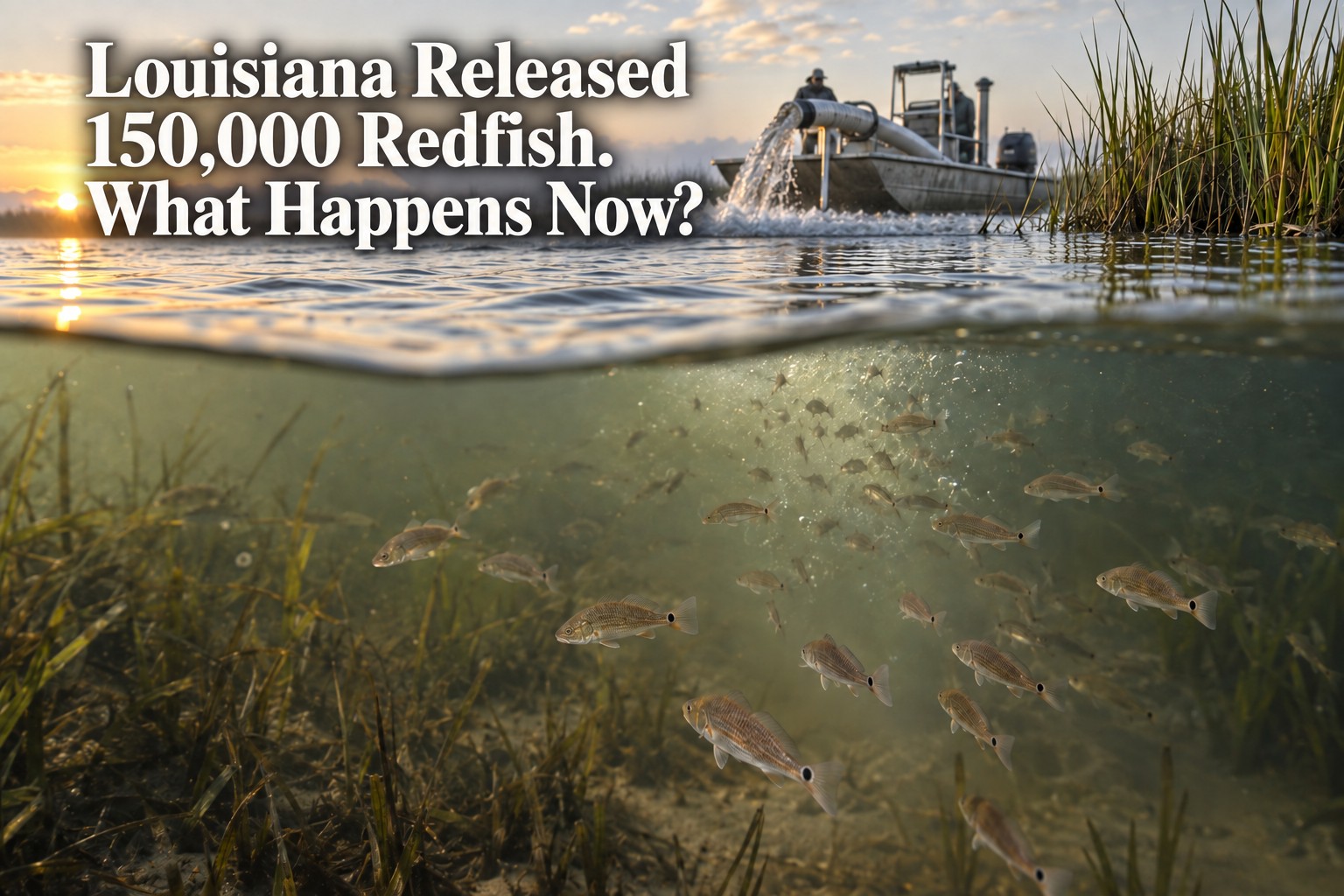
Louisiana has entered the redfish-stocking business.
More than 150,000 hatchery-raised red drum were released this month into Calcasieu Lake, the Rigolets and waters around Grand Isle through a partnership involving the Louisiana Department of Wildlife and Fisheries, CCA Louisiana and the Recreational Fisheries Research Institute.
The fish were raised at the University of Southern Mississippi's Gulf Coast Research Laboratory before being transported to Louisiana. More than 50,000 went into Calcasieu Lake, followed by additional releases at the Rigolets and Grand Isle.
It is easy to look at 150,000 fish going into the water and think we just added 150,000 redfish to Louisiana.
We did not.
We released 150,000 small redfish into three very large ecosystems where they now have to find food, avoid predators, handle changing conditions and survive long enough to join the fishery. That is not an argument against stocking. It is simply the difference between releasing fish and successfully adding fish to a population.
And it is why the interesting part of this experiment starts now.
What to Watch
The questions that matter after release day
- How many hatchery fish survive long enough to recruit into the fishery?
- Can researchers distinguish stocked fish from a strong wild year class?
- Do results differ among Calcasieu Lake, the Rigolets and Grand Isle?
- Would a larger program complement habitat work and fishing regulations?
150,000 sounds like a lot
It is a lot of fish if you are standing beside the truck.
Spread them between three parts of the Louisiana coast and the number starts to look different. Then compare Louisiana's first effort with a state that has been doing this for decades.
Texas began stocking red drum in the 1980s. During the period examined in published research on the state's stock-enhancement program, Texas was releasing roughly 25 million to 30 million red drum fingerlings annually into its bays and estuaries.
That is not a criticism of what Louisiana just did. If anything, it helps put the release into perspective.
Louisiana is not replacing a wild redfish population with hatchery fish. At this scale, we are beginning to find out whether hatchery-produced fish can supplement that population and whether a larger stocking program could eventually make sense here.
Before anybody decides the program worked—or did not—we need to know what happens next.
Most of them will not become somebody's 24-inch redfish
A fingerling has a difficult life ahead of it. It has to survive transportation and release, adjust to its new environment, find food and avoid becoming food itself. After that come weather, disease and everything else a wild juvenile redfish has to survive.
But successful release is not the same thing as successful recruitment into the fishery.
That is the number that eventually matters.
How do we know whether it worked?
This is where Texas becomes particularly useful.
Texas did not spend decades releasing redfish and simply assume the program worked because fishermen continued catching redfish. Researchers developed ways to distinguish hatchery fish from naturally produced fish and study what happened after release.
Genetics became one of those tools. A 2008 study used 16 nuclear microsatellite markers to distinguish hatchery-released red drum from wild fish in Galveston and Aransas bays. Researchers identified 30 hatchery fish among 321 red drum sampled from Galveston Bay and 11 among 970 sampled from Aransas Bay.
Later research expanded that work across nine Texas bays and estuaries. Recovery of hatchery fish varied substantially depending on place and time, ranging from 0.28% to 17.65% across the areas and periods studied.
That is important for Louisiana.
Suppose we release 150,000 fish into an estuary and redfish numbers increase the following year. Did stocking cause the increase?
Maybe. Or perhaps wild reproduction produced a strong year class. Environmental conditions could have favored juvenile survival. Fish could have moved into the area from somewhere else.
Seeing more redfish afterward is not enough by itself to tell us what the stocking accomplished.
We have to be able to find the hatchery fish again.
What would success actually look like?
Imagine Louisiana releases 150,000 redfish and, over the following years, researchers recover evidence of only a small fraction of them.
Was the program successful?
That depends on what Louisiana was trying to accomplish. We would need to know the expected survival rate, what the program cost, how many stocked fish successfully recruited into the population and whether their presence produced a measurable benefit beyond what natural reproduction was already providing.
A larger recovery rate would obviously be encouraging, but even that would not answer every question. Researchers would still want to know how the fish dispersed, whether results differed among release locations and how stocked fish interacted with wild juveniles using the same habitat and food.
The Texas research makes that point particularly well. Carson and his coauthors found no relationship between the number of red drum released per hectare and the percentage of hatchery fish later recovered.
More fish going in did not automatically mean a greater hatchery contribution showing up later.
That is why the release number alone does not tell us very much.
The meaningful question is what Louisiana gained at the population level.
Genetics belongs in the conversation
There is another issue worth watching if Louisiana eventually turns this experiment into a much larger program.
A wild redfish population contains genetic diversity produced by a large spawning population. A hatchery starts with a much smaller group of broodfish. If hatcheries repeatedly produce enormous numbers of offspring from too few parents, managers have to consider how those fish could affect the genetic diversity of the population they are intended to supplement.
The 2008 Texas study found lower allelic richness among recovered hatchery fish than among broodfish and wild fish. Researchers also found that the contributions of individual broodfish to recovered hatchery offspring were not evenly distributed.
That does not mean Louisiana's 150,000-fish release represents a genetic problem. Saying that would go well beyond the evidence.
It means genetics belongs in the conversation if Louisiana eventually begins releasing millions of hatchery redfish year after year.
That is not a reason to stop stocking. It is a reason to do it carefully.
Stocking, habitat and harvest rules do different jobs
A hatchery can add fish. Habitat work can improve the places juvenile fish use. Harvest rules can change how many fish survive the inshore fishery. Evaluating one tool should not require pretending it can replace the others.
A hatchery cannot make marsh
There is a bigger question behind all of this: What problem are we trying to solve?
Louisiana tightened recreational redfish regulations in 2024 after LDWF biological data indicated the stock was experiencing overfishing, escapement had fallen below the state's 30% minimum limit and biomass was declining. The resulting regulations reduced the recreational daily limit from five fish to four, established an 18- to 27-inch slot and prohibited recreational harvest of red drum over 27 inches.
But hatcheries and habitat solve different problems.
A hatchery can produce fish. It cannot produce a grass bed, rebuild an eroding marsh edge or replace nursery habitat disappearing into open water.
That distinction has already become part of the Louisiana conversation. Some commercial and charter fishermen have questioned whether money supporting fish stocking could provide greater long-term benefits if directed toward marsh and habitat restoration instead. The stocking effort received funding support from Cameron LNG and Sempra Infrastructure, among others.
It is a fair question, but it does not necessarily require choosing one or the other. Stock enhancement, habitat restoration and fishing regulations are different management tools, and each can be evaluated on what it actually accomplishes.
The danger would be allowing an easily photographed release of thousands of baby fish to substitute for the harder work of understanding why a population needs help in the first place.
Because once a hatchery redfish enters the marsh, it needs the same thing a wild redfish does: a place where it can survive.
Louisiana does not have to reinvent this
Being late to redfish stocking has one major advantage: somebody else has already spent decades making mistakes, asking questions and collecting data.
Texas has decades of experience raising, releasing and studying hatchery red drum. Researchers there have examined genetics, recovery, survival and differences among bays and years.
The results have not always produced simple answers.
In the 2014 study, researchers identified 167 hatchery-released fish among 4,325 red drum sampled between fall 2006 and spring 2009. When combined with fish identified in the earlier study, researchers had 208 recovered hatchery fish to examine across multiple bays and year classes. Recovery varied dramatically by place and time, and simply increasing the number released per hectare did not correspond to a higher percentage of hatchery fish recovered.
Louisiana gets to start with that body of work instead of starting from zero.
And that means we should expect more from this program than a release-day head count.
How many survived? Where did they go? How quickly did they disperse? How many eventually appeared in fisheries sampling or fishermen's catches? Did results differ among Calcasieu, the Rigolets and Grand Isle? What did Louisiana learn that should change the next release?
Those answers will not come from pictures of fish going down a hose. They will come from what happens afterward.
The release was not the result
There is something undeniably cool about releasing 150,000 redfish into Louisiana water. I am a fisherman. I am not going to pretend otherwise.
Give me a truck full of baby redfish and a hose pointed toward the marsh and I am probably going to stand there and watch too.
But the number going into the water is not how we should judge this.
This is Louisiana's first redfish restocking effort. We should treat it for what it really is: the beginning of an experiment.
If, several years from now, researchers can identify these fish in sampling surveys and fishermen's catches, measure how well they survived, compare results among three very different release areas and use those answers to improve future releases, we will have learned something useful.
Maybe Louisiana eventually discovers that large-scale redfish stocking is worth doing. Maybe it works particularly well in some estuaries and poorly in others. Maybe the numbers show that money produces more fish when invested elsewhere. Or maybe stocking becomes one useful tool alongside habitat work and fisheries regulation.
Right now, we do not know enough to answer that, and we should not pretend we do.
More than 150,000 little redfish just disappeared into Louisiana water.
Now comes the part that actually matters: finding out what happens to them.
Sources and further reading
This article was prepared from release reporting, Louisiana's red drum management record, peer-reviewed Texas stock-enhancement research and federal habitat information.
- Louisiana Sportsman: CCA Louisiana, RFRI and LDWF release 150,000 redfish
- LDWF: New red drum regulations effective June 20, 2024
- LDWF: Biological rationale for the red drum rule change
- Karlsson et al. (2008): Genetic identification of hatchery-released red drum
- Carson et al. (2014): Recovery of hatchery-released red drum across Texas bays
- Louisiana Illuminator / New Orleans CityBusiness: Fishermen question LNG industry's fisheries effort
- NOAA Fisheries: Coastal habitat restoration in Louisiana
Reader Response
Have a local correction, firsthand detail, or respectful response?
Send it to LAInshore.com. Include the article title, what you saw or know, and any source, photo, document or public record that helps verify it. Useful reader responses may inform corrections, updates or follow-up reporting.
Send a response