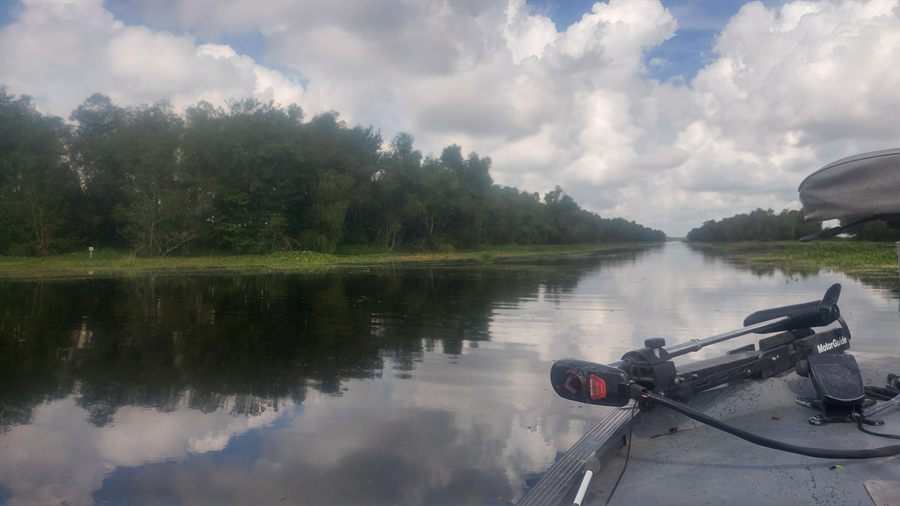
A mud motor can make a Louisiana angler feel like the map got bigger.
That is the appeal.
A shallow flat that used to be a maybe becomes reachable. A muddy drain at low water becomes passable. A stump field that would make a normal outboard owner wince becomes part of the route. A pond behind a stretch of grass, a broken marsh pocket, a backwater duck lease edge, a dead-low bayou, a skinny cut across a flat: all of it starts looking less like a barrier and more like an invitation.
That is what mud motors changed.
They did not just add another option to the boat market. They changed what "reachable" means in Louisiana marsh country. For duck hunters, they opened routes to ponds and blinds that used to require a push pole, pirogue, or a very specific water level. For anglers, they opened more shallow water, more back marsh, more low-water options, and more confidence to keep going when a conventional outboard would already be trimmed up and begging for mercy.
That is the good part.
The harder part is what happened after more people could get there.
Access spreads. Pressure spreads. Noise spreads. Conflict spreads. The line between public water, private leases, fragile marsh, duck hunting areas, fishing holes and "I can physically run there" gets thinner. A mud motor can solve one problem and create three more behind it.
That does not make mud motors bad.
It makes them important enough to talk about honestly.
Balanced Question
Access and pressure grew together
- Mud motors helped people reach shallow, difficult water.
- That access also increased noise, conflict and pressure in some places.
- Rules, leases, public land and habitat conditions all matter.
- The issue is not whether every mud motor is a problem.
What mud motors actually are
A mud motor is a shallow-water propulsion system built for places where a standard outboard struggles: mud, vegetation, stumps, shallow flats, soft bottom, flooded timber and broken marsh.
The two common ideas most people talk about are long-tail mud motors and surface-drive motors.
A long-tail uses a long shaft that lets the operator work the prop through shallow, muddy, stumpy or vegetated areas. It is usually slower and more physical, but it can be good at grinding through bad spots and working a boat out when things get ugly.
A surface drive is shorter, faster and more outboard-like in operation. It is built to run shallow and handle tough conditions, but it often suits longer runs and higher-speed travel better than a traditional long-tail where conditions allow.
That is the simple version. Brand people can argue the rest at the launch until dark.
The important point is that mud motors are purpose-built for water and bottom conditions that used to limit where many anglers could go.
That is why they matter in Louisiana.
What they made possible
Mud motors gave anglers and hunters more confidence in low water.
A falling tide used to end some plans early. A shallow mud flat could lock a route down. A stump field could make a canal feel risky. Heavy vegetation could make a standard outboard useless. A bayou that ran fine on normal water could turn into a push-pole workout when the north wind pulled everything out.
Mud motors changed that calculation.
They help in shallow flats, muddy bottoms, cypress and stump country, grass, lilies, low-water ponds, marsh cuts and routes where a regular prop would be too exposed or too easy to clog, bend or destroy.
For anglers, that can mean reaching redfish water that does not have enough depth for a bay boat. It can mean crossing a shallow flat instead of running the long way around. It can mean getting out of a pond after the water falls. It can mean fishing a low-water winter marsh, a back bayou, a duck-pond edge after season, or a protected area when wind has made bigger water miserable.
For hunters, it can mean reaching blinds and ponds that define a season.
For emergency work, storm recovery, trapping, research and land management, shallow-water rigs can also be practical tools. In Louisiana, the same technology that gets a weekend hunter to a blind can also help someone move through flooded, broken or debris-filled country when ordinary boats are limited.
That practical usefulness is why mud motors are not going away.
The pressure problem
The same thing that makes a mud motor valuable makes it controversial.
It turns hard-to-reach water into reachable water.
That matters because hard-to-reach water used to protect itself. Not completely, but enough. A pond that required a push pole, a high tide, a long idle, or a willingness to get stuck did not get the same pressure as an easy canal bank. A shallow flat that could only be fished on certain water levels had built-in rest days.
Mud motors reduced some of that natural protection.
More people can reach shallow reds. More people can run back duck ponds. More people can cross skinny cuts. More people can fish areas that used to be left alone except by locals, leaseholders, trappers, airboats, pirogues or people who knew the water extremely well.
That does not mean every mud-motor owner is burning up the marsh.
It means access technology changes pressure.
Fishing has seen this before. GPS changed routes. Mapping apps changed confidence. Trolling motors changed boat positioning. Power-Poles changed shallow-water control. Forward-facing sonar changed the way people target fish they can see on a screen. Mud motors changed where people can physically go.
The pressure question is not whether they are legal or useful.
The question is what happens when enough people use them in the same skinny water.
The noise and conflict problem
Mud motors are not quiet tools.
Some are louder than others. Some operators are more respectful than others. But the sound of a mud motor carrying across a marsh is different from a trolling motor, paddle, or idling outboard.
That matters in places where fishing, duck hunting, leases, camps, private property, public water, guiding and recreational use overlap.
A hunter sitting a pond at daylight may see a mud boat as intrusion. An angler trying to work a shallow shoreline may see a mud boat as unnecessary disturbance. A landowner or leaseholder may see it as trespass pressure. A mud-motor operator may see all of them as people trying to block access to water he can legally reach.
That is the collision point.
Louisiana marsh access is already complicated. Water can look open while involving private water-bottom claims, lease boundaries, refuge rules, WMA restrictions, posted canals or local conflict. A mud motor does not solve that. It can make it easier to arrive at the dispute faster.
This is where "I can run there" becomes a bad legal theory.
Physical access is not always legal access. Before running a mud motor through a marsh, anglers should verify whether the area is public, private, WMA, refuge, leased, posted, restricted by season, restricted by motor type, or subject to special access rules.
The motor may get you in.
It may not make you right.
Public land rules matter
One reason this topic cannot be treated like a simple gear review is that mud motors are regulated differently in some public areas.
LDWF tells public-land users to check individual WMA, refuge and conservation-area profiles and current regulations. That matters because motor rules can be area-specific, seasonal and different from general boating rules.
Biloxi WMA is a useful warning. The current LDWF Biloxi profile states that all types of mud boats or air-cooled propulsion vessels are prohibited. Some LDWF and regulation-publication records have used more specific Biloxi wording around straight shaft long-tail air-cooled mud motors and horsepower limits. That kind of difference is exactly why readers should check the current profile, current season regulations and the managing agency before running.
At Pass-a-Loutre WMA, LDWF has announced seasonal limits on operation of mud boats and air-cooled propulsion engines, including a prohibition after 2 p.m. from Sept. 1 through Jan. 31, with specified passes excepted.
Federal refuges can have their own rules too. A Southeast Louisiana refuge publication for Delta National Wildlife Refuge reported that surface-drive outboards such as Go-Devil or Mud Buddy style motors are strictly prohibited there, and federal public-use materials prohibit air boats, mud boats and air-cooled propulsion engines on some refuge waters.
That does not mean every public marsh has the same rule.
It means readers should check the specific WMA, refuge, conservation area, local rule or land manager before assuming a mud motor is allowed.
A motor being sold legally is not the same thing as legal operation everywhere.
The erosion and habitat question
The habitat debate around mud motors is harder to reduce to one sentence.
People who worry about mud motors often point to marsh damage: prop scars, torn vegetation, disturbed bottom, widened trails, soft banks getting cut, repeated runs through skinny water, and fragile areas being treated like roads.
Mud-motor users often push back. They argue that Louisiana marsh is already shaped by storms, erosion, nutria, saltwater intrusion, boat wakes, canals, subsidence, dredging, oilfield cuts and habitat loss far bigger than one boat running a muddy trail. They also argue that responsible operation on existing routes is different from tearing up vegetation just to prove a boat can go there.
Both points can be true.
A single careful operator using an existing trail is not the same thing as a parade of boats chewing through a shallow pond edge. But "other things hurt the marsh too" is not a free pass to add avoidable damage.
The honest middle is this: mud motors are capable of operating in places where the margin for habitat damage is smaller.
That puts more responsibility on the operator.
If the boat is digging, rutting, plowing vegetation, throwing mud across a flat, widening a trail, or turning a pond edge into a lane, the question should not be "can this motor do it?"
The question should be "should I be doing this here?"
The safety problem
Mud motors create a different kind of confidence, and confidence can get people in trouble.
A boat that runs very shallow can still get stuck. A rig that will cross a mud flat can still hit a stump, crab trap, pipe, log, oyster shell, duck blind post, sunken debris or old oilfield junk. A surface drive that runs fast in shallow water still needs room to stop, turn and avoid people.
Louisiana boating rules still apply.
Operators have to run at reasonable speeds for conditions, keep proper lookout, stay in control, obey no-wake and speed zones, avoid obstructing channels and operate sober. Required safety equipment still matters. Life jackets still matter. Navigation lights still matter. Engine cut-off switches matter, especially on tiller boats.
LDWF says boats must carry required U.S. Coast Guard-approved PFDs and that operators of certain motorboats under 26 feet with hand-tiller outboards over 10 horsepower must attach the engine cut-off switch while the motor is running and the vessel is underway.
Mud-motor operators born after Jan. 1, 1984 also need to understand Louisiana's boater education requirement for operating motorboats over 10 horsepower, unless an allowed exception applies.
A mud motor does not make a boat exempt from the basics.
It just lets the operator make bad decisions farther from help.
The duck lease collision
Mud motors sit right in the middle of the duck hunting and fishing access fight.
A lot of the best shallow-water redfish country overlaps with waterfowl country. Ponds, broken marsh, grass edges, mud flats, bayous and interior cuts that look like fishing opportunity in one season may be part of someone's hunting setup in another.
That creates hard feelings.
A fisherman may see public water. A duck hunter may see a leased pond that was brushed, maintained and paid for. A landowner may see private marsh. A guide may see client water. A mud-motor owner may see a route nobody could stop him from physically running.
Louisiana's access law and lease culture are already emotional. Mud motors add reach and speed to that emotion.
The best practical rule is simple: verify before you run, respect posted areas, learn seasonal restrictions, do not tear through active hunting setups, and do not assume every open-looking pond is fair game.
That will not solve every argument.
It will prevent some of the dumb ones.
This is not anti-mud-motor
There is a lazy version of this article that says mud motors ruined the marsh.
That version is wrong.
Mud motors are tools. They help people hunt, fish, work, manage land, reach camps, move through low water and use boats in places where standard outboards struggle. In the right hands, they are one of the most practical Louisiana boat tools ever built.
There is also a lazy version that says every concern is just jealousy or access gatekeeping.
That version is wrong too.
A tool that opens more water also changes pressure, disturbance and conflict. A tool that can run through fragile places creates habitat questions. A tool that lets people reach disputed areas faster creates access problems. A tool that costs money and performs better in bad conditions changes who can get where.
That is worth discussing without turning every mud-motor owner into a villain.
What readers should verify before running one
Before running a mud motor in a new area, ask the boring questions.
- Is the boat registered and equipped legally?
- Do I meet boater education requirements?
- Do I have required PFDs, lights, fire extinguisher if required, sound device and engine cut-off switch use covered?
- Is the area public, private, WMA, refuge, conservation area, leased or posted?
- Are surface drives allowed there?
- Are long-tails allowed there?
- Are there horsepower limits?
- Are there time-of-day restrictions during waterfowl season?
- Are there no-motor, no-wake, idle-only or closed-area rules?
- Am I using an existing route or creating a new scar?
- Am I about to disturb hunters, anglers, camps, wildlife or fragile vegetation unnecessarily?
That checklist is not exciting.
Neither is paying a ticket, buying a lower unit, getting stranded in a cold marsh, or being the guy everybody talks about at the ramp for the wrong reason.
What mud motors really changed
Mud motors changed the marsh by making more of it reachable.
That is their genius.
That is also the source of every hard question around them.
They made low water less final. They made shallow routes more reliable. They helped anglers and hunters reach places that used to require more water, more muscle, more patience or more local knowledge.
But they also helped spread pressure into thinner places. They made crowding possible in water that once filtered people out. They created new conflict where public use, private claims, duck leases and fishing access already rubbed raw. They raised habitat and safety questions that cannot be brushed off just because the motor is useful.
That is the honest answer.
A mud motor is not good or bad by itself.
It is a tool that gives the operator more reach.
What matters is what the operator does with it.
Because in Louisiana, getting there has never been the only question.
Sometimes the harder question is whether you should have gone there that way.
Source record
Sources checked include GO-DEVIL product and comparison pages for basic long-tail and surface-drive context, LDWF boating safety and education pages, LDWF public-land pages, LDWF WMA notices and profiles, and federal refuge public-use materials.
- GO-DEVIL: long-tail engines
- GO-DEVIL: engine comparisons
- LDWF: required boating equipment
- LDWF: boating regulations
- LDWF: mandatory boater education
- LDWF: WMAs, refuges and conservation areas
- LDWF: Biloxi WMA profile
- LDWF: Pass-a-Loutre WMA mud boat regulations notice
- FWS: Southeast Louisiana Refuges Complex annual user brochure
- Delta National Wildlife Refuge motor-restriction notice summary
Reader Response
Have a local correction, firsthand detail, or respectful response?
Send it to LAInshore.com. Include the article title, what you saw or know, and any source, photo, document, or public record that helps verify it. Useful reader responses may inform corrections, updates, or follow-up reporting.
Send a response