Three Access Examples
Built, moved and rebuilt.
Bayou Pigeon shows major investment expanding public access. Reserve shows a necessary project moving the starting point until 2030. Delta Farms shows a temporary closure can be part of building a better public facility.
Louisiana can have public water that fishermen cannot practically reach.
That sounds contradictory.
It is not.
A fisherman may have every legal right to fish a lake, bayou or stretch of coastal water and still face a more basic problem:
Where do you put the boat in?
The answer depends on something fisheries discussions often treat as secondary — access.
Boat launches are not particularly glamorous pieces of infrastructure. They rarely generate the attention given to habitat restoration, fisheries regulations or major coastal projects.
But the water itself is only part of what makes a fishery accessible.
Fishermen also need a way to reach it.
Access is more than a legal question
Discussions about fishing access often center on whether water itself is public or private.
Louisiana has plenty of reasons for that debate.
State law declares navigable waters and their beds public things, while Louisiana’s statutes, Civil Code, property boundaries and decades of legal disputes create a much more complicated picture once specific waterways are involved.
That argument is larger than this one.
Because even where the right to use the water itself is not in dispute, another question remains:
How does the public physically get there?
Most recreational fishermen cannot simply appear on public water.
They need a road capable of reaching it. They need somewhere to park. They need a ramp with enough water to launch.
Sometimes they need a private property owner willing to provide that access.
Louisiana law even recognizes the distinction. Revised Statute 9:1251 protects landowners who voluntarily allow people to cross private property to reach water and specifically says that continued public use does not automatically create a public right of passage.
Public water and public passage to reach it are not necessarily the same thing.
Access is infrastructure
Louisiana already treats boating access as infrastructure.
The Louisiana Department of Wildlife and Fisheries administers boating and fishing access grants funded through the federal Sport Fish Restoration Program. Eligible projects include acquisition, development and renovation of facilities that improve public boating and fishing access.
In other words, the state does not assume that having water is enough.
Access has to be built and maintained.
Bayou Pigeon in Iberville Parish demonstrates the scale that can require.
The boat launch is an important gateway into the Atchafalaya Basin, used for recreation as well as commercial fishing, crawfishing and other activity.
CPRA and Iberville Parish invested more than $2 million, expanding the facility from two launch lanes to seven, adding floating piers and improving parking and trailer facilities.
The project was not restoring fish habitat.
It was restoring and expanding the public’s ability to reach it.
When the starting point moves
The opposite situation is playing out near Reserve.
On July 15, 2026, the U.S. Army Corps of Engineers closed the Reserve Relief Canal Boat Launch and restricted travel through the canal as part of construction of the West Shore Lake Pontchartrain hurricane-protection system.
The Corps projects the closure will remain in effect until the project is completed in June 2030.
During that period, the canal cannot be used from the launch to reach Lake Maurepas or the I-10 canal.
The Corps directs boaters instead to Pete’s Landing, Akers Boat Ramp and the Bonnet Carré Spillway Boat Launch.
The water did not close.
The starting point moved.
That distinction matters.
When a convenient launch is no longer available, a fisherman may have to drive farther before the boat touches water, run farther once it does, or both.
Then the costs begin adding up.
More highway fuel.
More boat fuel.
More time.
Potentially a longer run across exposed water.
For someone with a large boat and plenty of range, the difference may be manageable.
For someone fishing close to home from a small aluminum boat or older rig, moving the starting point can materially change where that person can safely and affordably fish.
Access is not experienced equally.
Closures are not always losses
Not every closed launch represents declining access.
Sometimes a launch closes because government is improving it.
In April 2026, Lafourche Parish temporarily closed the Delta Farms Boat Launch while a new public facility was being constructed. The parish project includes a new concrete ramp, wharves, parking improvements, bulkhead work and other upgrades.
Public facilities also close at times for repairs or when conditions make continued use unsafe.
That distinction matters.
Louisiana is not simply watching access disappear.
Government agencies and parishes are also spending money to maintain, rebuild and expand it.
The broader point is that access requires continual investment.
A launch does not remain usable forever because somebody poured concrete there decades ago.
Private launches are part of the system too
Publicly owned ramps are only part of Louisiana’s access network.
Private marinas and launches have long connected fishermen with the water while also providing parking, fuel, bait, ice and other services.
But private businesses have to make economic sense.
Waterfront property has other potential uses. Insurance and maintenance cost money. Storm damage accumulates. Owners retire. Families make decisions about inherited property.
A marina does not have to become a subdivision for access to change.
It only has to stop operating as a launch.
That does not mean a private owner owes the public permanent access.
It means communities and governments have reason to pay attention when a heavily used access point disappears and no practical alternative replaces it.
One ramp can represent miles of water
The importance of a boat launch is easy to underestimate on a map.
It occupies almost no space.
The access it creates can cover thousands of acres.
A single ramp can provide a starting point for an entire system of bayous, canals, lakes and marshes.
Families may use the same launch for generations without ever thinking about it as infrastructure.
It is simply where they go fishing.
Then something changes, and suddenly everyone understands what the ramp was doing.
That is why access cannot be measured merely by counting acres of public water.
Distance matters.
Parking matters.
Depth at the ramp matters.
Condition matters.
Cost matters.
For some fishermen, whether they can safely reach productive water in the boat they already own matters most of all.
The access question Louisiana should be asking
Louisiana spends enormous amounts of time discussing what happens to its water.
We debate fish populations, seasons, habitat, coastal restoration and harvest.
We also debate who has the right to travel or fish in particular waters.
Those questions matter.
But there is another one worth asking whenever Louisiana plans its waterfront:
Can ordinary people still get to the water?
Not theoretically.
Actually get there.
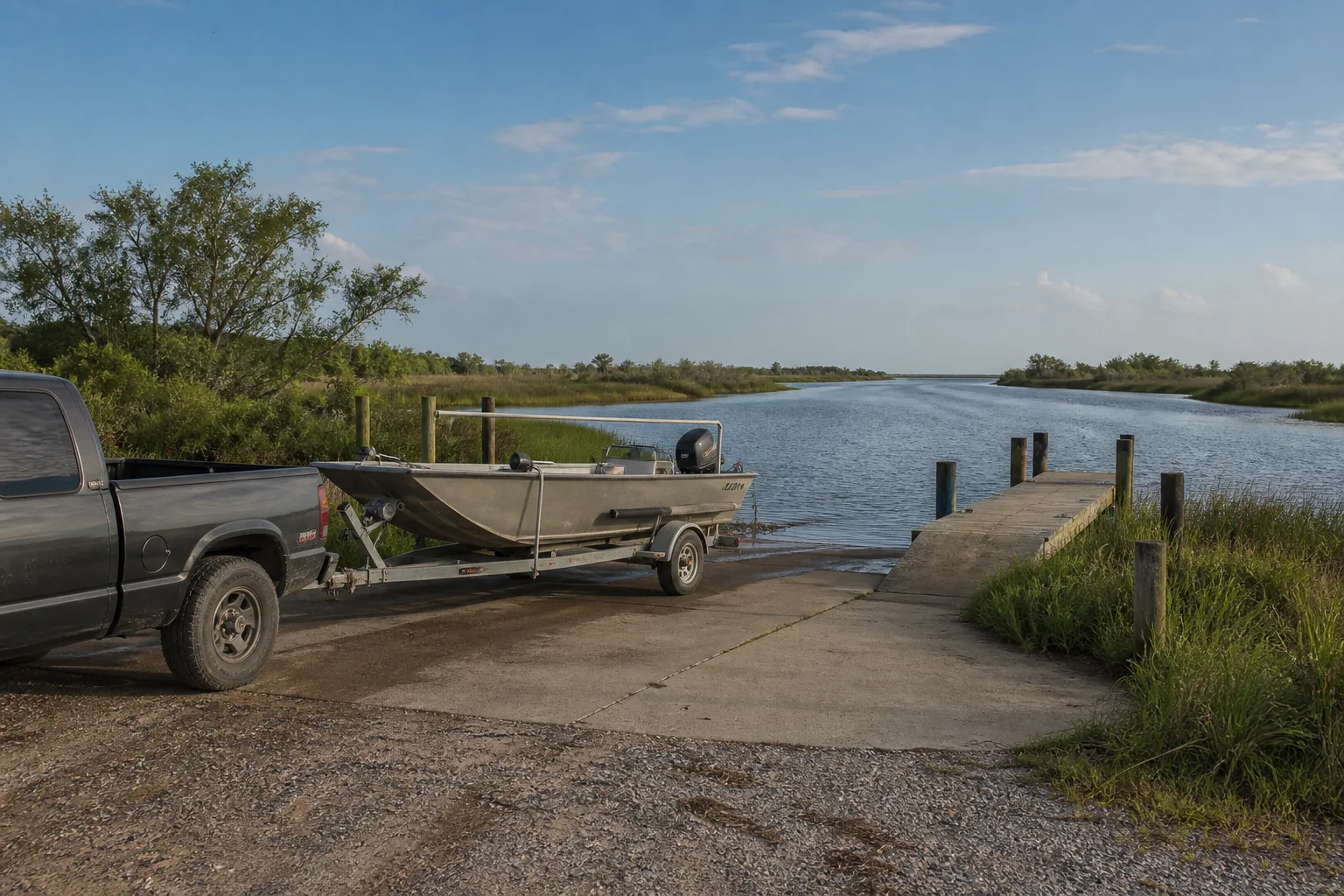
Can someone pull a 16-foot boat behind an old pickup, find a usable ramp, park the trailer and spend a morning fishing without the logistics becoming more difficult than the trip itself?
There will not be one statewide answer.
Bayou Pigeon shows Louisiana investing millions to improve access. Reserve shows how a necessary infrastructure project can temporarily move access somewhere else. Delta Farms shows a closure can actually be part of creating a better public facility.
Those examples point toward the same conclusion.
Public access is not something Louisiana simply has.
It is something Louisiana has to maintain.
The state does not only need fishable water.
It needs practical ways for people to reach it.
Source File
Sources and additional reading
- Louisiana Department of Wildlife and Fisheries: Boating and fishing access grants
- CPRA: Bayou Pigeon Boat Launch improvement project
- U.S. Army Corps of Engineers: Reserve Relief Canal Boat Launch closure
- Lafourche Parish: Delta Farms Boat Launch reconstruction closure
- Louisiana Revised Statute 9:1251: Passage to or from waters or recreational sites
- Louisiana Civil Code Article 452: Public things and common things subject to public use