Interview File
About This Interview
- Participant
- Tommy Rodriguez
- Role
- Louisiana resident, Marine Corps veteran, outdoorsman and community advocate
- Interview Format
- Written responses to the series’ standard five questions
- Series
- Where Fishermen Fit — Interview 005
Series Note
Editor’s Note
Tommy Rodriguez submitted his responses through the same public process available to other participants in this series. His answers have been lightly edited for spelling, punctuation, clarity and formatting without changing their meaning.
Every participant in Where Fishermen Fit receives the same five questions and the opportunity to answer them in their own words. Publication does not imply endorsement by LAInshore.com.
From Wyoming to the Louisiana Marsh
Tommy Rodriguez did not grow up in Louisiana, but over the past four years, he and his family have begun building a life here.
Tommy is a Marine Corps veteran, outdoorsman and community volunteer who moved from Wyoming to Louisiana with his wife and two children. His outdoor experience includes western big-game hunting, planning do-it-yourself hunting trips and, more recently, fishing Louisiana’s marshes.
That background gives him the perspective of someone who values Louisiana’s outdoor traditions while still seeing the state, its coast and its fishing culture with relatively new eyes.
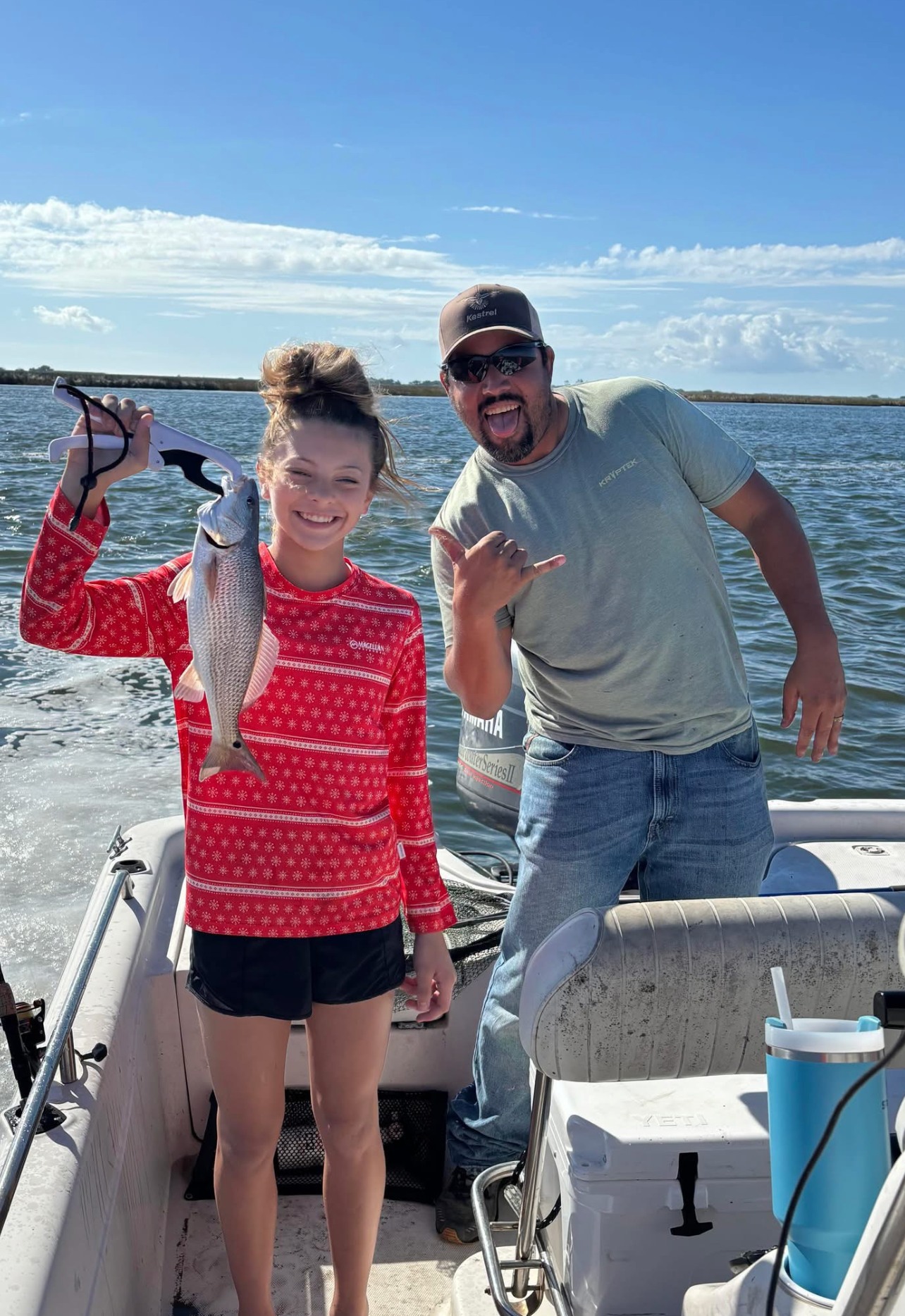
Tommy is also involved with Residents for Rural Integrity, a civic organization focused on protecting rural communities, encouraging responsible development and increasing public participation in local issues.
In his responses, Tommy recognizes the cultural and economic importance of both commercial and recreational fishing. He also argues that Louisiana needs stronger enforcement of existing fishery regulations and greater public involvement in decisions affecting wetlands, access and coastal communities.
His final message is straightforward: complaining on social media is not enough.
Question One
What role do Louisiana’s commercial and recreational fishermen play in the identity, economy and culture of this state?
“I think they both play a huge part in all aspects mentioned above,” Tommy wrote.
Louisiana’s geography, waterways and extensive coastal habitat support commercial seafood production, charter businesses and a recreational fishing culture that reaches far beyond the shoreline.
The Louisiana Department of Wildlife and Fisheries estimates that the seafood industry has an annual economic impact of more than $2.4 billion and that approximately one out of every 70 jobs in Louisiana is connected to it.
Tommy sees that economic activity as part of the state’s identity.
“Louisiana is known as the ‘Sportsman’s Paradise.’ The natural geographical characteristics of Louisiana’s waterways create a hotbed of life for all wildlife.”
Tommy Rodriguez
He also pointed to the number of charter operations working along the coast.
“There are hundreds, if not thousands, of fishing charter services, both inshore and offshore, all along the coast,” Tommy wrote. “That’s an incredible revenue-generating industry for the state.”
However, Tommy believes the economic importance of commercial fishing should not prevent the state from enforcing restrictions intended to protect habitat and recreational fisheries.
“I do, however, believe the commercial fishing industry needs more regulations,” he wrote. “Specifically, when these boats encroach within the buffer zone to the shore. There needs to be more enforcement and harsher penalties for these companies.”
Tommy referred to the economic influence of what he called “Big Fish,” arguing that the industry’s economic importance may make regulation and enforcement more complicated.
“Great for revenue for the state,” he wrote, “not so great when it comes to regulation when it’s one of your biggest assets.”
Louisiana’s commercial fisheries operate under different seasons, gear restrictions and boundaries, so Tommy’s criticism should be understood as a broad concern about enforcement rather than a claim about every commercial fisherman or fishery.
Question Two
Why are Louisiana’s wetlands important to the future of both working-water families and recreational anglers?
Tommy described Louisiana’s wetlands as places that provide habitat, food, protection and opportunity.
“The wetlands provide an incredible living environment, not just for fish, but for waterfowl as well,” he wrote. “Every living thing needs water.”
Wetlands provide feeding, shelter and nursery areas for commercially and recreationally important fish and shellfish. They can also improve water quality, reduce shoreline erosion and help buffer communities from storms and flooding.
“Wetlands provide everything from cover from predators, food and a safe place to reproduce.”
Tommy Rodriguez
For commercial fishermen, guides, recreational anglers and coastal families, those ecological functions have direct practical value. Healthy marshes support fish populations, seafood production, outdoor recreation and communities whose economies and traditions remain closely tied to the water.
Tommy framed that relationship in personal terms.
“If you spend enough time in and familiarize yourself with your local wetlands, it can provide a family with just about everything they need,” he wrote.
His answer reflects the way many Louisiana families understand the coast: not simply as scenery or undeveloped land, but as a source of food, income, recreation, knowledge and identity.
Question Three
What priorities should guide Louisiana as it balances coastal recreation, fishery management, commercial livelihoods, recreational access, private property rights and environmental protection?
Tommy returned to enforcement.
“I stand behind what I said previously: more enforcement for commercial fishing,” he wrote. “I believe that is hurting the recreational fishing community.”
He expressed particular concern about game fish being caught in commercial nets.
“So many game fish are caught in nets each year and killed because the commercial industry has little enforcement on the regulations that are already in place,” Tommy wrote.
Commercial gear can catch species other than the intended target, although the extent varies by fishery, gear, season and location. Tommy did not provide a statewide estimate for the number of game fish he believes are killed each year.
His larger argument is that Louisiana should consistently enforce the rules it already has before responding to every conflict by creating more regulations.
“If the state would enforce the regulations in place, as they are written, I don’t think there would be a great need to add more regulations.”
Tommy Rodriguez
“Adding regulation without enforcement is just a dog-and-pony show for the public and recreational fishermen.”
Commercial fishermen may also argue that broad criticism fails to distinguish between lawful operators and those who violate existing rules. Tommy’s answer reflects one side of that continuing debate: regulations should be meaningful and consistently enforced rather than adopted mainly to demonstrate that something has been done.
Question Four
What fisheries, access, coastal or working-water issue should Louisiana residents be paying closer attention to right now, and why?
Tommy identified two closely connected issues: wetland loss and public fishing access.
“The loss of Louisiana’s wetlands and public fishing access deserves greater attention,” he wrote.
Louisiana has lost nearly 2,000 square miles of land since the 1930s. The state’s Coastal Protection and Restoration Authority warns that, without continued action, Louisiana could lose as much as another 3,000 square miles under the higher environmental scenario used in the 2023 Coastal Master Plan.
“Every year, coastal land loss reduces fish habitat, increases storm vulnerability and limits opportunities for both commercial and recreational users,” Tommy wrote.
The consequences of land loss extend beyond changes on a map. As marsh converts to open water, fish habitat can change, shorelines become more exposed and communities may lose natural protection from waves and storms.
Public access creates a different but related challenge.
“At the same time, conflicts over water access highlight the need for clear policies that respect property rights while preserving Louisiana’s long-standing fishing traditions.”
Tommy Rodriguez
Louisiana’s access disputes often involve complicated questions about navigable water, privately claimed canals, submerged land and boundaries that may not be visible from a boat.
Those disputes place two legitimate interests against one another.
Property owners expect legally recognized property rights to be respected. Fishermen want clear boundaries that allow them to know where they may legally travel and fish without risking confrontation or citation.
Tommy did not offer a specific legal or legislative solution, but he argued that the issues deserve attention now because of their potential long-term effects.
“Addressing these challenges now will have lasting impacts on our economy, seafood industry and outdoor heritage,” he wrote.
Question Five
What message would you like to leave with Louisiana’s fishermen, seafood workers, guides, recreational anglers and coastal families who care about protecting these livelihoods and traditions?
“Get involved,” Tommy wrote.
“That means doing more than just ranting on social media.”
For Tommy, involvement means moving beyond comments, arguments and frustration into actions that can become part of a public record or influence an actual decision.
“Write letters to the proper authorities, show up to public meetings, talk to people, join an organization that’s trying to help what we all love,” he wrote.
Public meetings, regulatory hearings and written comment periods can be slow, technical and frustrating. They are also often dominated by the people, businesses and organizations willing to participate consistently.
When ordinary fishermen and coastal residents remain absent, their interests may be discussed without their experiences being fully represented.
Tommy believes protecting Louisiana’s outdoor traditions requires a broader group of people to carry that responsibility.
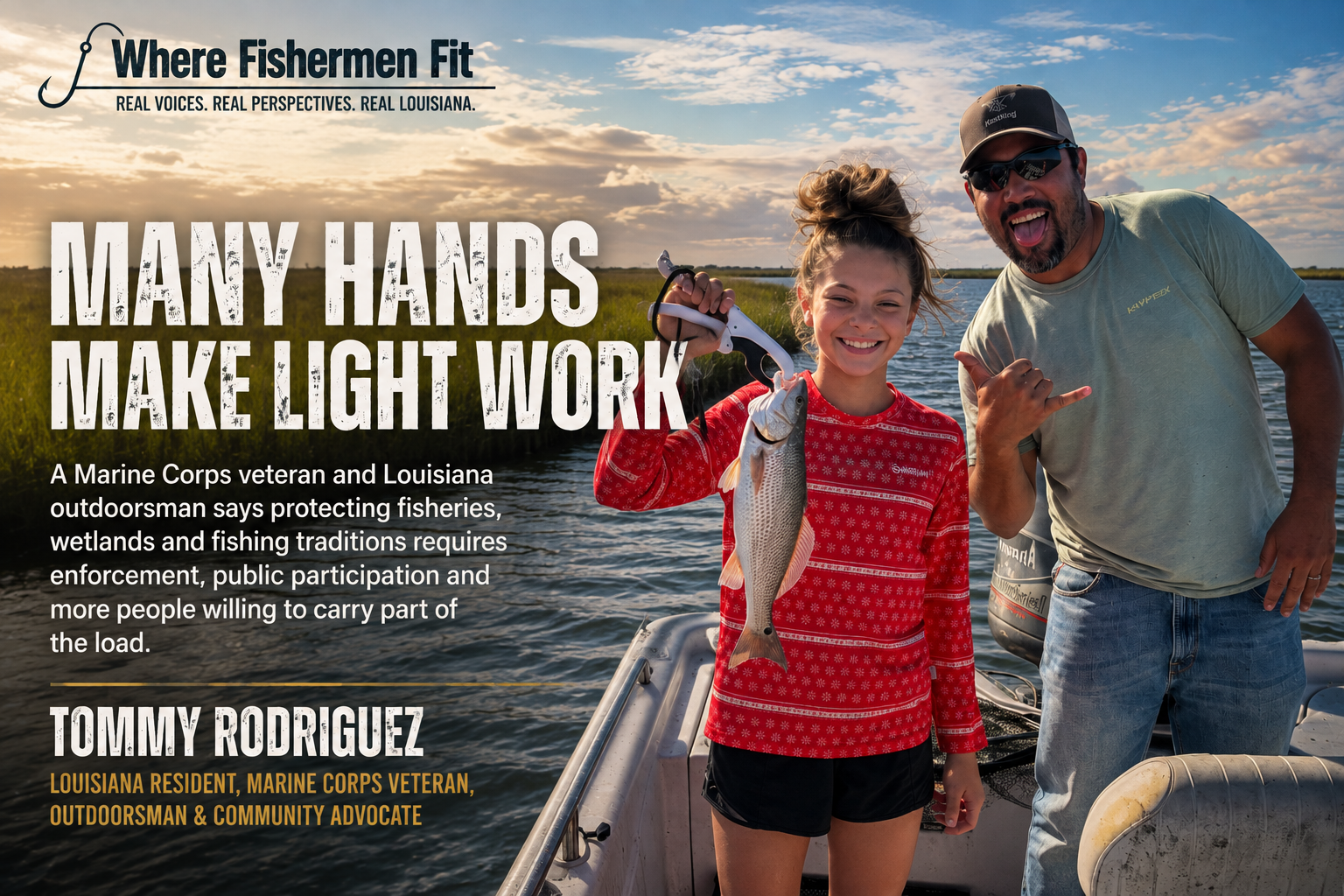
“If we all give a little more, then we don’t have to rely on a few to give all. Spread the load. Many hands make light work.”
Tommy Rodriguez
Participation as a Form of Stewardship
Tommy’s answers reflect the perspective of a Louisiana resident, veteran, outdoorsman and community volunteer who believes existing rules should be enforced and that people who care about fishing and rural communities must participate in the public decisions shaping them.
Some commercial fishermen may disagree with his assessment. Others may share his concern about operators who violate existing rules while objecting to criticism that treats commercial fishing as a single, unified interest.
Louisiana’s fishing future will be shaped by commercial fishermen, recreational anglers, charter captains, scientists, seafood workers, property owners, conservation organizations, regulators, lawmakers and coastal residents—often with different experiences and competing priorities.
Tommy’s contribution to that conversation is less about proposing one final answer than about asking more people to accept part of the responsibility.
Not only online.
Not only when a decision has already been made.
But in the meetings, letters, organizations and public discussions where Louisiana’s future is being negotiated.
Sources and Further Reading
Reporting Sources
- Louisiana Department of Wildlife and Fisheries — Seafood Industry Economic Impact
- Louisiana Coastal Protection and Restoration Authority — A Changing Landscape
- U.S. Geological Survey — Why Are Wetlands Important?
- U.S. Geological Survey — Coastal Wetlands Geonarrative
Statements of opinion, interpretation and policy preference attributed to Tommy Rodriguez are his own. LAInshore.com added context where needed to distinguish broad claims from documented statewide findings.
Reader Response
Have a local correction, firsthand detail or respectful response?
Send it to LAInshore.com. Include the page title, what you saw or know, and any source, photograph, document or public record that helps verify it.
Send a response