Interview File
About This Interview
- Participant
- Jeff Plumlee
- Role
- Assistant professor and fisheries extension specialist
- Interview Format
- Written responses to the series’ standard five questions
- Series
- Where Fishermen Fit — Interview 003
Series Note
Editor’s Note
Plumlee submitted his responses in writing. They have been lightly edited for punctuation, consistency and formatting.
Every participant in Where Fishermen Fit receives the same five questions and the opportunity to answer them in their own words. Publication does not imply endorsement by LAInshore.com.
A Fisheries Scientist Working Between Research and the Dock
Jeff Plumlee works where fisheries science meets the people who depend on it.
He is an assistant professor in the LSU AgCenter School of Renewable Natural Resources and the state fisheries specialist for Louisiana Sea Grant and the Louisiana Cooperative Extension Service.
His path to Louisiana has taken him through fisheries research along both the Gulf and Atlantic coasts. Plumlee earned a bachelor’s degree in marine fisheries and a master’s degree in wildlife and fisheries sciences from Texas A&M University, followed by a doctorate in ecology from the University of North Carolina at Chapel Hill.
Before joining LSU in 2023, he studied fisheries recruitment and changing environmental conditions through postdoctoral work with the University of South Alabama and Dauphin Island Sea Lab.
At LSU, Plumlee studies how fish move through coastal systems, how habitat supports productive fisheries and how that science can inform resource management. His extension role also puts him in direct conversation with fishermen, managers and other coastal stakeholders—the people who see changes in Louisiana’s fisheries from the water, the dock and the seafood business.
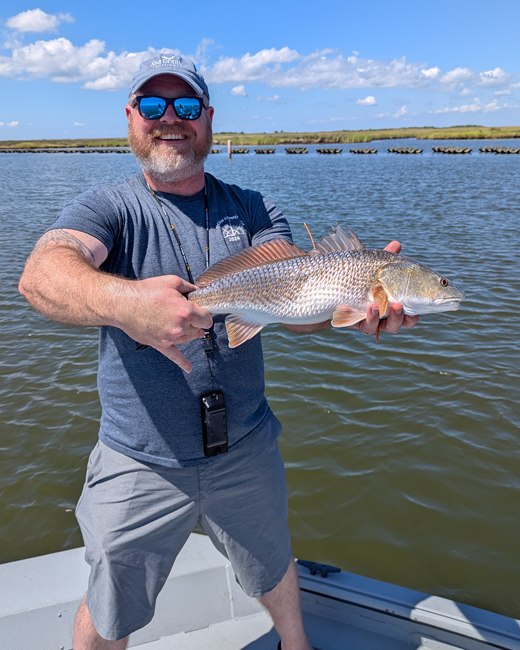
Louisiana’s fisheries depend on more than healthy populations of fish and shellfish.
They also depend on wetlands, working waterfronts, seafood processors, fuel docks, ice plants, local buyers and the coastal communities that have kept fishermen on the water for generations.
Question One
What role do Louisiana’s commercial and recreational fishermen play in the identity, economy and culture of this state?
Louisiana is widely known as a Sportsman’s Paradise. The state’s abundant natural resources support recreational fishing opportunities that generate billions of dollars in economic benefits each year.
Equally important, Louisiana’s commercial fisheries help feed the nation. Over the past five years, Louisiana has consistently ranked among the top five states in the United States for fisheries landings by both volume and value.
Seafood is woven into Louisiana’s cultural and economic identity. Communities such as Hopedale, Venice, Morgan City, Intracoastal City and Cameron are iconic examples of places built on generations of fishing heritage.
At the heart of this identity are Louisiana’s fishermen. They sustain coastal communities, support local economies and preserve traditions that have defined the state for generations.
“As fishermen thrive, so too does Louisiana, because where the fishermen go, there goes Louisiana.”
Jeff Plumlee
Question Two
Why are Louisiana’s wetlands important to both working-water families and recreational anglers?
Louisiana’s fisheries are inseparable from its wetlands.
These productive coastal habitats serve as vital nursery grounds for many of the state’s most economically and culturally important species.
White shrimp, brown shrimp, blue crab, red drum, spotted seatrout and numerous other fish and shellfish depend on Louisiana’s wetlands during the most vulnerable stages of their lives. They use these areas for feeding, growth and protection from predators.
Wetlands also provide essential protection for coastal communities.
They act as a natural buffer that can reduce storm impacts, limit saltwater intrusion into drinking water supplies and slow shoreline erosion.
For communities along Louisiana’s rapidly changing coast, healthy wetlands help protect roads, docks, businesses, homes and other critical infrastructure.
The same wetlands that sustain Louisiana’s fisheries also help sustain the people, communities and way of life that depend on them.
Question Three
What should Louisiana prioritize when balancing coastal restoration, fishery management, commercial livelihoods, recreational access, private property and environmental protection?
Coastal restoration is the process of rebuilding what has been lost and protecting what remains.
Louisiana’s wetlands are fundamental to the state’s economy, culture and identity. They support productive fisheries, sustain coastal communities and provide protection from storms and erosion.
Restoring and protecting Louisiana’s coast takes many forms.
That includes using dredged sediment to rebuild areas of lost marsh, constructing living shorelines and rock barriers to reduce erosion, and reconnecting the Mississippi River with surrounding wetlands so natural sediment can once again build land as it has for thousands of years.
Each restoration approach offers unique benefits and challenges. No single solution can solve every problem.
“The uncomfortable truth is that doing nothing is not a viable option.”
Jeff Plumlee
Failing to protect and restore Louisiana’s coast will accelerate the loss of wetlands, communities, fisheries and cultural traditions that define the state.
While restoration may be complex and imperfect, the cost of doing nothing is far greater and could result in irreversible losses.
Question Four
Are there any fisheries, access, coastal, seafood or working-water issues Louisiana residents should be watching closely?
The infrastructure supporting Louisiana’s fishing industry is steadily disappearing.
Ice plants, fuel docks, working waterfronts, fishing vessels and the fishing families that depend on them are being lost from coastal communities across the state.
These facilities and services are essential to keeping commercial fisheries operational. Many have declined or disappeared because of economic pressures, storm impacts and changes within coastal industries.
Seafood processing facilities, once the backbone of many South Louisiana economies, have also become increasingly uncommon.
In some areas, commercial fishing activity has declined not because fish are unavailable, but because fishermen lack local buyers and processing capacity for their catch.
This trend should concern all Louisianans who value the state’s seafood industry and fishing heritage.
Protecting fisheries requires more than conserving fish habitat. It also requires sustaining the coastal communities, businesses and working waterfronts that allow fishermen to remain on the water and continue supplying Louisiana seafood for future generations.
Question Five
What message would you like to share with Louisiana fishermen, seafood workers, guides, anglers and coastal families trying to protect both their livelihoods and traditions?
“If you value Louisiana seafood and fisheries, support our local fishermen and buy Louisiana seafood.”
Jeff Plumlee
More Information
Jeff Plumlee’s Work
More information about Plumlee and his work is available through the Fish EcoDynam Lab.
The Series
About Where Fishermen Fit
Where Fishermen Fit is an ongoing LAInshore.com interview series created to give people connected to Louisiana’s fisheries, coast and working water a fair opportunity to explain what they see.
Participants receive the same five questions and the same opportunity to answer them openly.
This is not an endorsement series, a political series or a gotcha format.
The goal is to hear from recreational fishermen, commercial fishermen, charter captains, scientists, public officials, seafood workers, marina owners, conservation organizations, coastal residents and others whose lives and work are connected to Louisiana’s water.
Previous interview in the series: Rep. Joe Orgeron on Wetlands, Fisheries, Public Access and Louisiana’s Coastal Future
Reader Response
Have a local correction, firsthand detail or respectful response?
Send it to LAInshore.com. Include the article title, what you saw or know, and any source, photograph, document or public record that helps verify it.
Useful reader responses may inform corrections, updates or follow-up reporting.
Send a response