Before the work starts
Three things to check in a coastal notice
- Where the project is proposed and what work the applicant describes.
- Which documents show the route, footprint or affected water.
- When and how the public can submit a comment.
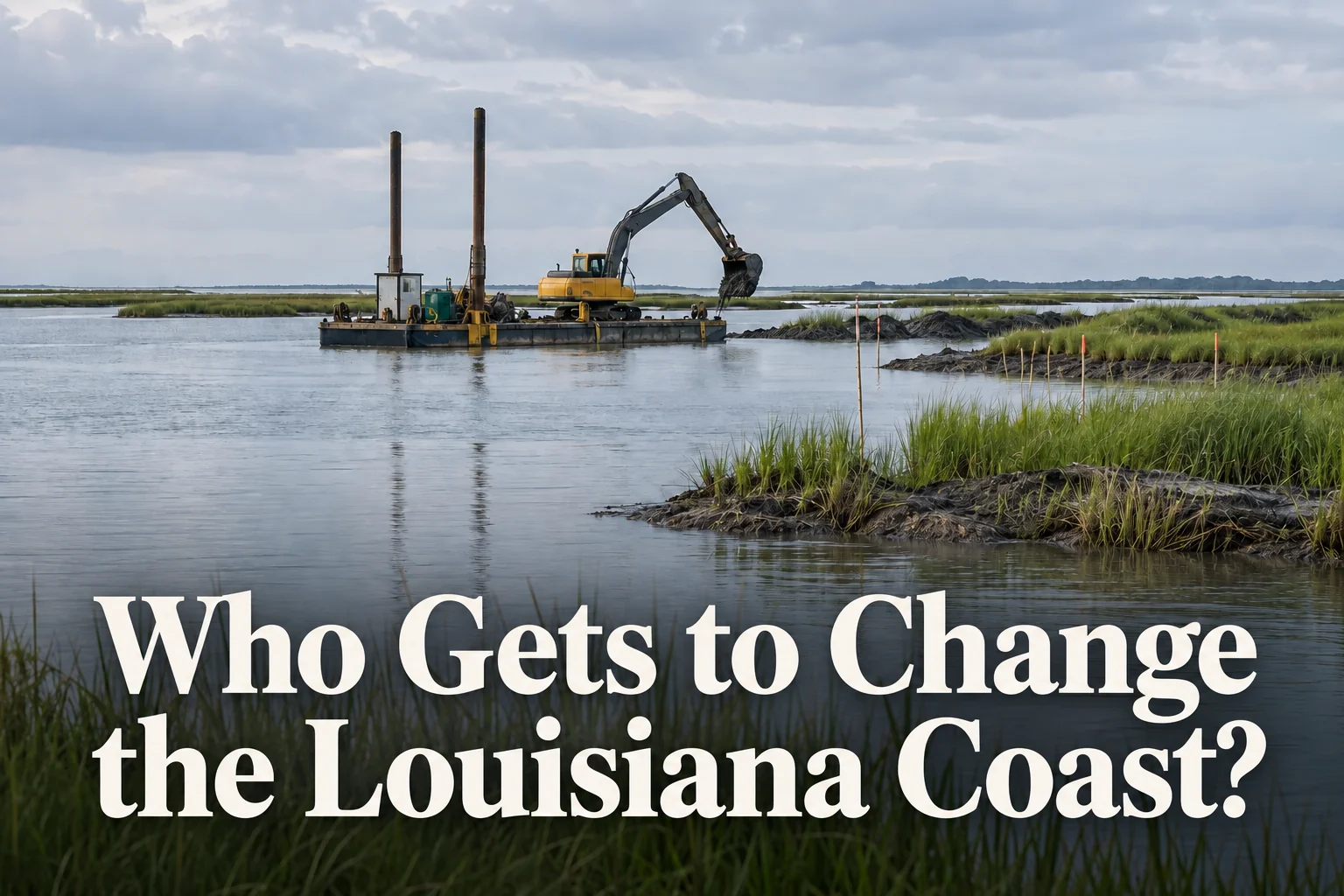
There is a particular kind of Louisiana fishing conversation we've probably all had. You run somewhere you've fished for years and something is different. Maybe there's an excavator sitting on a barge, survey stakes showed up along a canal, an old structure is gone or somebody is laying pipe through a marsh you've crossed a hundred times.
Eventually somebody asks: What the hell are they doing back here?
Then the phone calls start. Somebody posts a picture on Facebook. Somebody knows a guy who knows a guy. By that evening there are six different explanations, three conspiracy theories and at least one person absolutely certain somebody sold the marsh to somebody from Texas.
Meanwhile, there's a decent chance the real answer had been sitting online for weeks.
A surprising amount of the work that physically changes Louisiana's coast goes through a public permitting process before the first excavator shows up. The applications aren't hidden, and neither are many of the opportunities to comment on them. Almost nobody I know who fishes regularly checks them.
Maybe we should.
There is a list
Louisiana's Department of Conservation and Energy maintains a public page containing Coastal Management Public Notices. It isn't exciting. There aren't fishing reports, nobody is holding a 7-pound trout in the thumbnail, and the projects tend to have names that look more like filing-cabinet labels than places anybody would recognize.
Start opening them, though, and things get interesting.
As of September 16, 2026, the state's active Coastal Use Permit notices included an oil-and-gas flowline removal in Lake Borgne, pipeline and structure removal in Jefferson Parish, work involving the Maurepas Swamp, drainage work in Lafourche Parish, a coastal mitigation bank amendment, a pump station, bulkhead work and a project crossing six Louisiana parishes. There were also derelict-vessel removal projects involving several southeast Louisiana parishes. Louisiana DCE: Coastal Management Public Notices
These aren't abstract planning exercises. They involve the same marshes, lakes, bayous, canals and estuaries where people fish. And beside many of them is something fishermen rarely think about: an opportunity to submit comments.
Wait. We can comment on this stuff?
Yes, although not on everything that happens along the coast, and submitting a comment doesn't give anybody veto power over somebody else's property or project.
Louisiana law requires a Coastal Use Permit before a "use of state or local concern" covered by the coastal permitting program can begin. Uses of state concern include certain dredge-and-fill activities, projects involving state-owned lands or water bottoms, state publicly funded projects, projects crossing parish lines and mineral activities such as oil and gas exploration and production. Louisiana Revised Statutes §49:214.25; §49:214.30
There are exemptions. Different activities fall under different rules. Some matters are handled locally, and other projects can involve additional state or federal permits. Louisiana law specifically defines a Coastal Use Permit as being in addition to other permits or approvals that may be required. Louisiana Revised Statutes §49:214.23
The law also exempts a number of activities from Coastal Use Permit requirements, including normal maintenance and repair of existing structures, fishing and hunting themselves, certain agricultural activities and other specifically defined uses. Louisiana Revised Statutes §49:214.34
Coastal permitting isn't one giant permission slip covering everything that happens south of Interstate 10.
But for a lot of work that can physically alter coastal Louisiana, there is a paper trail. More importantly for fishermen, that paper trail can appear before the physical trail does.
That's the part fishermen should care about
We spend an incredible amount of time arguing about Louisiana's coast after something changes. A shoreline disappears, a canal widens, water starts moving differently, a productive little pond silts in or an old structure gets removed. Then we start asking what happened.
Sometimes that's unavoidable. Coastal Louisiana is enormously complicated, and no fisherman is going to monitor every permit issued from Lake Pontchartrain to Cameron. But there is a difference between not knowing everything and not looking at all.
At any time, anybody with a phone can open Louisiana's Coastal Management Public Notices page and see projects moving through the process. You can see the applicant, parish, project description and public-comment deadline. For many notices, you can also open the electronic files and start digging into what is actually proposed.
Take the Lake Borgne project listed on the September 16 notice page. McMoRan Oil & Gas applied for a project involving removal of a flowline associated with a well in St. Bernard Parish. The notice was posted September 8, with a public-comment deadline of October 3. Louisiana DCE, Permit P20260572
That's 25 days between the notice date and the deadline.
Miss the window and the work boat or pipeline crew may be a lot closer than the application.
Fishermen know things maps don't
This is where I think fishermen routinely undervalue themselves.
A permit application might contain engineering drawings, coordinates, environmental assessments and pages of technical information. All of that is useful, but it may not contain what the guy who has fished that shoreline since 1998 knows.
He may know there used to be grass there, or that the little drain on the north end carries shrimp out after a hard west wind. A commercial fisherman may know juvenile shrimp stack into a particular section of marsh every year. A charter captain may have watched a shoreline retreat over thousands of trips. A duck hunter may know that what looks like an insignificant pond on a map connects to another piece of marsh when the water gets high.
None of that makes someone a biologist, hydrologist or engineer. Being a fisherman doesn't automatically make an observation correct, either. But spending hundreds or thousands of days on the same water can produce useful knowledge about a place.
The trick is explaining what you've seen without pretending to know more than you do.
Don't write "This will ruin the fishing"
Let's say a proposed project crosses a flat you've fished for 15 years.
You could submit: "I oppose this project because it's going to destroy the fishing."
Maybe you're right, but you haven't given the reviewer much to work with.
Now consider something more specific:
"The proposed work appears to cross the shallow flat along the eastern shoreline of the bay. I have regularly fished this area from April through October for approximately 15 years. Submerged vegetation has historically been present there, and juvenile redfish and shrimp regularly use the area during higher tides. Has the applicant surveyed submerged vegetation along the proposed route, and what measures are proposed to limit turbidity or disturbance in that area?"
Now you've identified a place, described what you've observed, explained how long you've observed it and asked a question that can actually be answered.
You don't need a biology degree to say what you've seen. You just need to be honest about the difference between what you have observed and what you think it means.
That's a distinction we could probably use more of everywhere.
Public comment isn't a popularity contest
A permit comment isn't a Facebook poll. A pile of angry comments doesn't automatically kill a project, and Louisiana's coastal-management program has to deal with a coast where environmental, economic, infrastructure and community interests routinely overlap.
That's important because the Louisiana coast doesn't belong to any single interest. Commercial fishermen use it. Recreational fishermen use it. Oil and gas companies, ports and shipping companies use it. Families live there. Communities need flood protection. Landowners have rights. Industries employ people, and wildlife needs habitat.
Those interests are going to collide.
That's real coastal management, and it's why simply sorting projects into "good" and "bad" isn't very useful. A pipeline can be necessary and still deserve scrutiny. A restoration project can rebuild habitat while changing access or water movement. Removing an old structure can have different effects depending on where it is and what has grown around it.
The better question is: What does this particular project actually do to this particular place?
Then prove as much of the answer as we can.
The coast is too important for team sports
We tend to pick a side before we understand the project: industry versus environmentalists, commercial versus recreational, development versus conservation, government versus everybody. Pick your jersey and start yelling.
Louisiana's coast is too complicated for that.
A project can create jobs and cause environmental damage. A restoration project can rebuild habitat and change access. Infrastructure can be necessary while still deserving scrutiny. A fisherman can oppose one project and support the next one without contradicting himself.
That's not fence-sitting. It's evaluating the thing that's actually in front of you instead of deciding what you believe based on which team proposed it.
Louisiana's coastal-management law itself describes the state's policy as seeking to protect, develop and, where feasible, restore or enhance coastal resources while considering the needs of people who depend on them. Louisiana Revised Statutes §49:214.22
With a coast disappearing and changing as quickly as ours, paying attention is probably the minimum we owe it.
Start looking before the excavator shows up
So here's something we're going to start doing at LA Inshore: we're going to watch these notices.
Not because every bulkhead deserves an investigation, every pipeline is a scandal or every permit application needs to become outrage bait. Most probably won't warrant a story at all. But when something shows up that could meaningfully affect fishing access, habitat, water movement or a place Louisiana fishermen regularly use, we're going to take a look.
You can too.
Bookmark Louisiana's Coastal Management Public Notices page. Every couple of weeks, open it and search your parish. Look for a bayou you recognize or a lake you fish. If something catches your attention, open the documents before forming an opinion.
If you know something about that piece of water that isn't obvious from a map, consider submitting what you've observed while the public-comment period is still open.
Louisiana fishermen already spend an enormous amount of time watching the coast. We watch tides, grass, salinity and shorelines. We notice canals widening. We watch shrimp move. We know where freshwater shows up and remember where it doesn't anymore.
Maybe some of those observations belong somewhere besides the bait-shop counter and Facebook.
So, who gets to change the Louisiana coast?
Government, industry, landowners, restoration agencies, parishes and communities all play some role. Nature certainly does.
And within Louisiana's coastal permitting system, the public sometimes gets a chance to speak before those changes happen.
That doesn't mean fishermen get their way. It means we have an opportunity to pay attention, ask questions and tell the people reviewing a project what we've actually observed.
That's a very different thing from complaining afterward.
The next time you round a bend and see an excavator sitting where there wasn't one last month, you can still ask:
What the hell are they doing back here?
But maybe we ought to start asking a few weeks earlier.
Source File
Sources and additional reading
The notice examples were checked against the state's September 16, 2026 update. Project listings and deadlines can change; use the current notice page before submitting a comment.
- Louisiana DCE: Coastal Management Public Notices and comment links
- Louisiana Revised Statutes §49:214.22: Declaration of public policy
- Louisiana Revised Statutes §49:214.23: Definitions
- Louisiana Revised Statutes §49:214.25: Types of uses
- Louisiana Revised Statutes §49:214.30: Coastal use permits
- Louisiana Revised Statutes §49:214.34: Activities not requiring a coastal use permit
- NOAA Office for Coastal Management: Louisiana
- U.S. Army Corps of Engineers, New Orleans District: Regulatory permits
LA Inshore encourages readers to open the original permit documents and primary sources before reaching conclusions about any individual project. A permit application tells us what is proposed. It does not tell us what opinion to have about it.