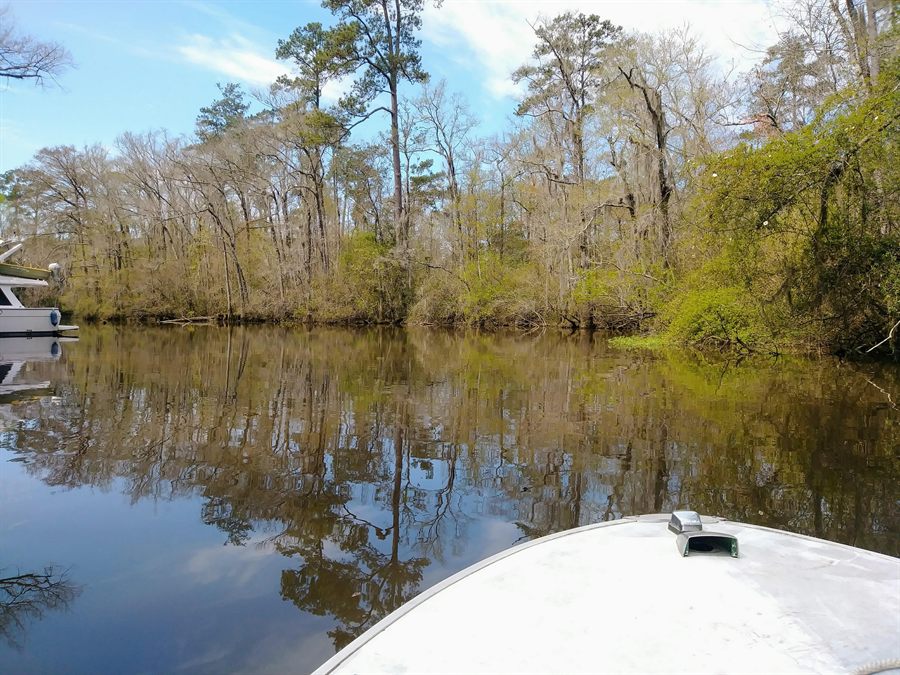
The trouble usually starts with a simple sentence.
"I floated there."
For most boaters, that feels like it should settle the question. If the boat floated in, the water was connected, the tide was moving, the fish were there, and there was no fence across the sky, it feels like public water.
In Louisiana, that is not always enough.
A canal, pond, trenasse, marsh cut or open-looking bay can feel public, look public and be physically navigable while still carrying private water-bottom claims or trespass risk. That gap between what anglers see from the boat and what the law may recognize on paper is why access fights keep coming back.
This is one of the most emotional issues in Louisiana inshore fishing because it hits every nerve at once: private property, public resources, old maps, coastal erosion, oilfield canals, hunting leases, recreational fishing, enforcement, liability, litter, gates, guides and generations of people using water that may or may not have been legally open.
The result is a system where a regular angler can do what seems reasonable and still end up being told to leave.
Floating there is not always legal access
The basic problem is that Louisiana water access does not turn only on whether a boat can physically pass.
In everyday language, anglers use "navigable" to mean "I can run my boat through it." In Louisiana access fights, navigability can mean something much more specific. It may involve whether a water body was legally navigable at statehood, whether it is a natural navigable water body, whether the water bottom is public or private, whether the route is a river, bayou, lake, arm of the sea, seashore, man-made canal, flooded private land, or some combination of those things.
That is where ordinary common sense starts to break down.
A marsh pond connected to tidal water may look no different from the next marsh pond. One canal may be an old natural bayou that was later widened. Another may be an oilfield cut across private property. Another may be a public route with private banks. Another may be claimed by both private interests and the state.
A map app may show blue water across all of them without explaining the property status underneath.
That is why "I floated there" does not always mean "I can legally fish there."
It may mean only that the water was deep enough to float a boat.
Why the Louisiana coast makes this worse
Louisiana's coast is not a clean shoreline with obvious public and private lines.
It is broken marsh, old bayous, spoil banks, duck ponds, pipeline canals, oilfield canals, navigation channels, leases, eroded land, artificial cuts, changing shorelines and private tracts that may have been bought, sold, leased or inherited long before today's angler ever saw them on a GPS screen.
A road has edges. A marsh often does not.
That matters because the physical landscape keeps changing while property records may lag behind, conflict with what people see, or rely on old legal categories that do not match modern boating reality. Land that was once dry can become open water. A small ditch can become a boat route. A spoil bank can become the only visible boundary. A gate can appear on a canal that generations of anglers used without being stopped.
The water moves. The law moves slower.
Louisiana also has a long history of private coastal ownership, mineral activity, oilfield access, hunting leases and working-marsh use. Many canals were dug for private or industrial purposes. Many marshes are tied to leases or private land. Some owners have allowed access for years, then changed their approach. Some areas became disputed only after pressure increased.
To anglers, that can feel like public water being taken away.
To landowners, it can feel like private property finally being defended.
What anglers argue
The angler and access-side argument starts with fairness and clarity.
If water is tidal, connected, fishable and deep enough for a boat, many anglers believe it should be open to the public unless there is a clear, legally valid reason it is not. They see fish and water as public resources. They buy licenses. They follow seasons and limits. They may cross water that looks like every other piece of marsh and have no practical way to know they are entering a disputed claim.
That is the heart of the frustration.
Anglers are not usually asking for the right to run across someone's yard, tear up a duck pond, cut a gate, damage marsh grass or litter a lease. Most are asking for a clear rule that lets them navigate and fish connected coastal waters without having to become property lawyers.
They also point out that access itself is part of Louisiana's fishing culture. The state markets its fisheries, sells licenses, promotes outdoor tourism and benefits from tackle shops, guides, boat dealers, marinas, gas docks and lodging. If ordinary anglers cannot tell where they can legally go, that culture gets squeezed.
Guides have a separate concern. Their livelihood depends on predictable access. A guide who takes clients into a disputed area risks confrontation, citations, business damage and safety problems. That uncertainty can make Louisiana harder to work in than states with clearer public-access rules.
The angler-side complaint is not just "we want everything."
It is often: tell us the rules in a way a person on the water can actually use.
What landowners argue
The landowner side starts from a different place.
Private property is not a small thing. Many coastal landowners own land, water bottoms, leases, camps, gates, canals, improvements or habitat work that cost real money to acquire and maintain. Some manage land for waterfowl hunting, cattle, timber, minerals, camps, conservation, mitigation or family use. Some deal with theft, vandalism, trash, cut locks, damaged gates, torn-up marsh, abandoned crab traps, illegal hunting or unsafe boat traffic.
From that view, the argument is not theoretical. It is boats entering property without permission, sometimes causing damage and sometimes leaving the owner responsible for the mess.
Liability is another concern. Whether every liability fear is legally justified in every situation is a separate question. But landowners often worry that if they allow broad access and someone gets hurt, they will be pulled into the problem.
There is also the issue of expectations. A landowner may have purchased property under a legal system that recognized private claims. A hunting club may have paid for lease rights. A company may have built and maintained a canal for access to its own property. From their side, a new public-access rule can look like the state changing the deal after the fact.
That is why this debate gets so heated.
Anglers see water and fish. Landowners see property and risk.
Both are looking at something real.
Why signs and enforcement create tension
A no-trespassing sign in the marsh does not always end the debate.
Some signs may mark valid private property claims. Some may be placed in areas where the legal status is disputed. Some may be old, vague, shot up, missing, unreadable or positioned where an angler does not see them until after entering. Some areas may not be posted at all, but still carry trespass risk.
That inconsistency creates mistrust.
Anglers may assume every sign is a bluff. That is not safe. Landowners may assume every boat that crosses a line is knowingly trespassing. That is not always fair. Enforcement officers may be asked to respond to a property complaint in an area where the legal line is not obvious from the water.
LDWF enforcement, sheriff's offices and courts do not all play the same role. A wildlife agent or deputy responding to a complaint is not the same thing as a final court ruling on title, water-bottom ownership or public-use rights. An officer may write a citation based on the information available. A court may later sort out whether the claim, notice, property boundary or legal theory holds up.
That is cold comfort to the angler holding the ticket.
This is one reason access advocates keep asking for better public maps, clearer state guidance and laws that can be understood before someone is already in trouble.
Why legislation keeps coming back
Louisiana access bills keep returning because the underlying problem has never been fully settled in a way that satisfies everyone.
Public-access proposals have tried different approaches. Some have focused on tidal waters connected to public water. Some have tried to protect navigation over running waters. Some have aimed to clarify that public use does not change ownership of private bottoms. Some have included exceptions for waterfowl season, permitted obstructions, damage to banks or vegetation, or liability protections for landowners.
Those details matter because every sentence creates winners, losers and edge cases.
Too broad, and landowners argue the state is taking private rights without compensation. Too narrow, and anglers argue the bill does not solve the real problem. Add exceptions, and the law may become too complicated to use. Remove exceptions, and opposition hardens.
That is why access legislation often sounds simple at the bait shop and becomes complicated at the Capitol.
Everybody likes "public access" until the bill has to define public, access, water, private bottoms, natural routes, man-made canals, banks, damage, liability, gates, hunting season, enforcement and who decides when there is a dispute.
What this article is not
This is not legal advice.
It is not a list of where to fish. It is not a declaration that any specific canal, pond, marsh cut or bay is open or closed. It is not a claim that every no-trespassing sign is valid. It is not a claim that every no-trespassing sign is invalid.
It is also not an excuse to ignore posted property, cut locks, run through duck ponds, damage marsh grass, litter, harass leaseholders or turn a disagreement into a confrontation on the water.
The practical advice is boring because the subject is risky: verify before you assume. Check current law. Use official sources where available. Pay attention to signs and gates. Avoid damaging banks, bottoms or vegetation. Do not rely only on map color or the fact that another boat went through.
If an area is important to your business or regular fishing, talk to someone who understands Louisiana property and water-bottom law.
That may not be satisfying, but it is safer than pretending the law is clearer than it is.
What readers should watch next
The next phase of Louisiana's access fight will likely come from several directions at once.
Watch the Legislature. HB 391-style and SB 391-style ideas are likely to keep returning because the political pressure has not gone away. Any bill that tries to define public use over private water bottoms will draw close attention from anglers, landowners, industry, hunting interests and coastal businesses.
Watch the courts. A single case can change how people understand a disputed route, but court decisions often depend on specific facts. That means one ruling may not answer every canal or marsh question.
Watch signage disputes. As more water gets posted, blocked or challenged, expect more fights over whether signs are clear, legal, enforceable or placed in disputed areas.
Watch access mapping. The biggest practical need for anglers is not another argument. It is usable information. Clearer public guidance, better water-bottom mapping and transparent ownership claims could reduce accidental trespass and bad confrontations.
Watch enforcement patterns. Who writes tickets, where complaints come from, whether citations stick, and how agencies explain their role will shape public confidence.
Most of all, watch whether Louisiana can create a system ordinary people can understand before they launch the boat.
Because right now, the problem is not just that some water is private and some water is public. The problem is that a lot of water looks the same from the console.
That is why access keeps coming back.
In Louisiana, the question is not always whether you can float there.
Sometimes the harder question is whether the law says you should have been there at all.
Source record
Sources checked: Louisiana Civil Code Article 450, Louisiana Civil Code Article 456, RS 41:1701 State Water Bottom Management, Taylor Porter's public-access legal explainer, 2018 HB 391 bill materials, and 2024 SB 391 bill language. This article is a general explainer, not legal advice.
Reader Response
Have a local correction, firsthand detail, or respectful response?
Send it to LAInshore.com. Include the article title, what you saw or know, and any source, photo, document, or public record that helps verify it. Useful reader responses may inform corrections, updates, or follow-up reporting.
Send a response