The Waterfront Chain
Boats need more than productive water.
Commercial fishermen need ice, fuel, buyers and places to unload. Charter and recreational boats need docks, launches and parking. All three sectors depend on mechanics, boatyards, welders, suppliers and roads.
Louisiana can restore a marsh and still lose a fishing community.
It can rebuild habitat, improve water quality and maintain healthy fish populations while something else changes along the shoreline.
The dock closes.
Then the ice house.
Fuel becomes harder to find.
A processor shuts down.
A boatyard disappears.
Eventually the boats may still have water to work.
The question becomes where they work from.
That is the working waterfront problem, and Louisiana has been dealing with versions of it for decades.
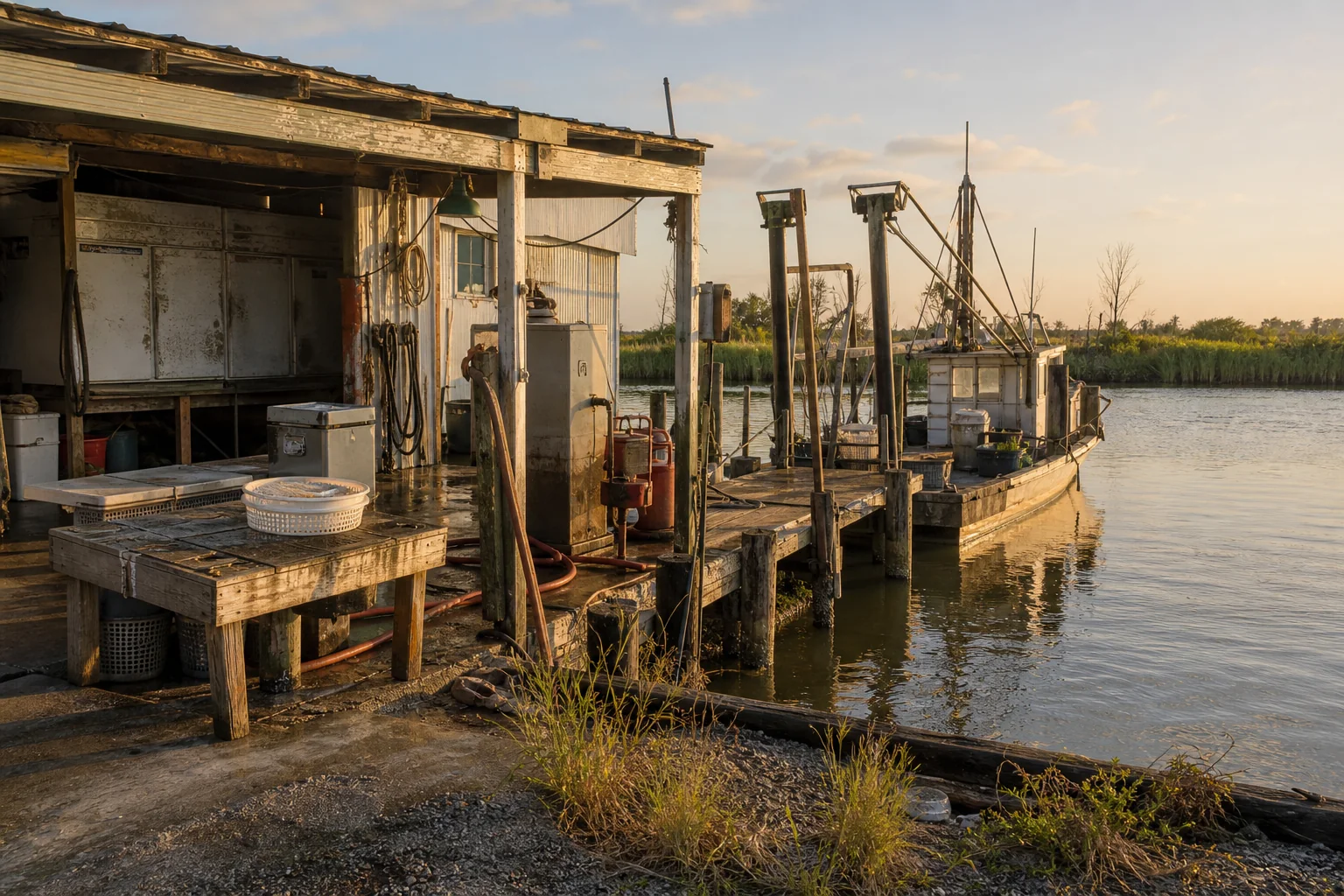
Fishing requires land
Fishing looks like an activity that happens on water.
Economically, much of it happens on land.
Commercial fishermen need places to unload catch. Seafood dealers and processors need facilities accessible to boats and trucks. Charter captains need docks. Recreational fishermen need launches, fuel and parking.
Everybody eventually needs maintenance.
Engines break. Hull damage happens. Trailers fail. Nets, electronics, pumps, refrigeration equipment and countless other pieces of the system need repair or replacement.
Those services tend to develop around waterfront communities because that is where the boats are.
When supporting infrastructure becomes harder to find, fishing becomes harder even if the fishery itself remains productive.
Louisiana learned just how interconnected that system is after some of its worst hurricanes.
When the waterfront breaks
After Hurricanes Katrina and Rita in 2005, Louisiana’s seafood industry was not dealing only with damaged boats.
Louisiana Sea Grant documented damage to harvesting gear, docks, storage facilities, ice plants, fuel docks and seafood processors.
Restoring ice alone became part of getting portions of the fleet working again.
That detail is easy to overlook.
Fish still existed in the water.
Boats still existed.
But a commercial boat catching perishable seafood needs somewhere to get ice before it leaves and somewhere to land its catch when it comes back.
A fishery can fail onshore even when the fish remain offshore.
Three years later, Hurricanes Gustav and Ike demonstrated the financial scale of the same problem.
Louisiana Sea Grant estimated average fisheries and aquaculture infrastructure losses from the two storms at roughly $152 million. The estimate included tens of millions of dollars in losses to seafood processors and docks and dealers, along with damage to marinas, vessels and aquaculture operations.
The numbers put a price on something fishing communities already understood.
The infrastructure surrounding a fishery is part of the fishery.
Ida did it again
Hurricane Ida struck southeast Louisiana in August 2021 and once again disrupted the systems surrounding commercial fishing.
NOAA temporarily modified or extended reporting requirements for portions of Louisiana’s federally permitted seafood industry because infrastructure and communications remained disrupted after the storm.
The federal government later approved a fishery-resource disaster determination covering Louisiana fisheries affected by Ida.
Storms are not the only threat facing working waterfronts.
But they reveal how dependent fishing is on things that do not swim.
Electricity. Ice. Fuel. Roads. Docks. Processors. Communications. Buyers.
Lose enough pieces at once and simply reopening the water does not reopen the fishery.
Louisiana has asked fishermen about this
The working-waterfront issue is not something being imposed on fishing communities from outside.
Louisiana has asked the industry directly about its future.
The Louisiana’s Seafood Future initiative brought together Louisiana Sea Grant, the Coastal Protection and Restoration Authority and the Louisiana Department of Wildlife and Fisheries to gather information from people working throughout the seafood industry as the coast changed around them.
The resulting work drew input from crabbers, shrimpers, oyster harvesters, finfishermen, dock workers and processors.
The 2019 findings report was based on public meetings and extensive industry surveys and focused not only on environmental change but on the ability of fishing businesses and communities to adapt to it.
That matters because Louisiana often talks about coastal change in acres.
The people working on the coast experience it in miles, fuel bills, lost docks, changing salinity, damaged businesses, places they can no longer work and new places they may have to go.
Those are different measurements of the same changing landscape.
Waterfront property has other uses
Storm damage is only one pressure.
A working dock occupies property that may be valuable for many other purposes.
Waterfront land can support residential development, recreational marinas, restaurants, short-term rentals and other uses.
Marine businesses also face the ordinary realities of succession, maintenance, insurance and changing markets.
An owner retires.
Children choose another career.
A hurricane damages a building that was already expensive to maintain.
A property becomes more valuable for another use.
Whatever the reason, when a working-waterfront business closes, recreating it somewhere else can be difficult.
Once it is gone
Building a new waterfront business is not as simple as leasing an empty storefront.
The property needs appropriate water access.
Different vessels require different depths and dock configurations.
Trucks may need room to enter, load and turn around.
Industrial or commercial activities have to coexist with surrounding land uses.
Permitting and environmental requirements may apply.
Then there is the cost of waterfront construction itself.
A seafood business that has occupied the same location for decades may continue partly because its docks, bulkheads, buildings and access already exist.
Recreating those assets somewhere else can be a very different economic proposition.
Commercial fishing depends on the shore
A commercial boat may spend its working day on public water, but its business depends on what happens when it comes back.
Where catch can be landed matters.
Where buyers operate matters.
Where ice and fuel are available matters.
Distance matters because seafood is perishable and boats consume fuel.
If fishermen must travel farther for basic services or to reach a buyer, the cost of participating in the fishery rises even if the season, regulations and allowable harvest remain exactly the same.
A fisherman can legally be allowed to catch seafood and still reach a point where doing so no longer makes economic sense.
That distinction deserves attention whenever Louisiana discusses the health of a commercial fishery.
Recreational and charter fishing use the waterfront differently
Recreational fishermen and charter operators are affected too, although not always in the same way.
A recreational fisherman towing a small boat may be able to move to another launch more easily than a commercial vessel can relocate its operations.
A charter captain may need reliable dock space close to productive water while also depending on parking and facilities for customers.
Commercial operations may require buyers, unloading equipment, ice or truck access that neither recreational nor charter fishermen need.
Those differences matter.
But the sectors also overlap.
A marina selling fuel to commercial boats may also fuel charter and recreational boats. A mechanic may work on all three. Welders, fiberglass shops, tackle stores, bait suppliers and other marine businesses can depend on a mixture of customers.
The waterfront does not divide itself as neatly as fisheries policy sometimes does.
Bayou Pigeon provides a good example.
CPRA describes the heavily used Atchafalaya Basin launch not only as a recreational facility but as infrastructure supporting commercial fishing, crawfishing and other commercial activity.
The same piece of waterfront can serve several Louisiana economies at once.
Adaptation is happening too
This is not only a story about loss.
Some Louisiana communities and agencies are trying different ways to keep fishing businesses viable as conditions change.
The Delcambre Direct Seafood project helped develop a model connecting fishermen directly with consumers, with support from the Port of Delcambre, Louisiana Sea Grant and the LSU AgCenter.
That approach later contributed to the broader Louisiana Direct Seafood effort.
Louisiana’s Seafood Future also produced ideas aimed at adaptation rather than simply preserving every part of the industry exactly as it had existed before.
One example was alternative oyster culture. Louisiana Sea Grant later received a $3 million grant to expand that sector, explicitly identifying it as an adaptation strategy raised by people in the oyster industry during Seafood Future workshops and surveys.
Those efforts do not solve every working-waterfront problem.
They demonstrate something more important.
Louisiana fishing communities are not simply waiting for somebody else to save them.
They are already trying to figure out what still works.
Restoration has a human component
Louisiana’s coastal restoration effort necessarily focuses heavily on land loss and habitat.
Without habitat, fisheries suffer.
Without wetlands, communities become more vulnerable.
But preserving the physical coast and preserving the ability of people to work from it are related, not identical, goals.
Healthy habitat does not guarantee that a fisherman has a nearby dock, buyer, fuel source or repair facility.
Likewise, preserving a section of coastline does not automatically preserve the businesses historically connected to it.
Louisiana’s own research into the future of its seafood industry recognizes that adaptation has to include the people and businesses operating on the coast, not only the geography around them.
If Louisiana intends to preserve fishing as a living industry and culture, working-waterfront infrastructure belongs in that discussion alongside habitat and fisheries management.
What are we actually trying to save?
Louisiana frequently describes fishing as part of its culture.
That is true.
But the culture depends on physical things and real businesses.
Someone owns the boat.
Someone fixes it.
Someone sells the fuel.
Someone makes the ice.
Someone unloads the catch.
Someone buys it.
Someone maintains the docks and launches connecting land to water.
All of those activities need somewhere to happen.
A healthy estuary is essential to Louisiana’s fishing future.
So are healthy fish populations and responsible management.
But those things alone do not make a fishing community.
The working waterfront is not scenery surrounding Louisiana fishing. It is part of the fishery itself.
Source File
Sources and additional reading
- Louisiana Sea Grant: Louisiana’s Seafood Future 2019 findings
- Louisiana Sea Grant: Fisheries infrastructure recovery after Katrina and Rita
- Louisiana Sea Grant: Gustav and Ike fisheries infrastructure loss estimates
- NOAA Fisheries: Post-Ida reporting flexibility for Louisiana seafood businesses
- NOAA Fisheries: Fishery resource disaster determinations
- CPRA: Bayou Pigeon Boat Launch improvement project
- Louisiana Sea Grant: Louisiana Direct Seafood and the Delcambre model
- Louisiana Sea Grant: Alternative oyster culture expansion grant